Two sharply contrasting views of Europe surfaced this week, one from Washington, the other from Brussels. These two visions imply very different futures for Europe. And for the world.
Both claim to defend values. Yet they arise from fundamentally different imaginations of what Europe is and what Europe ought to be.
One was the US National Security Strategy released on Friday, which depicted Europe as a civilisation in danger—‘drifting toward erasure’ through migration, demographic decline, and the hollowing out of identity.
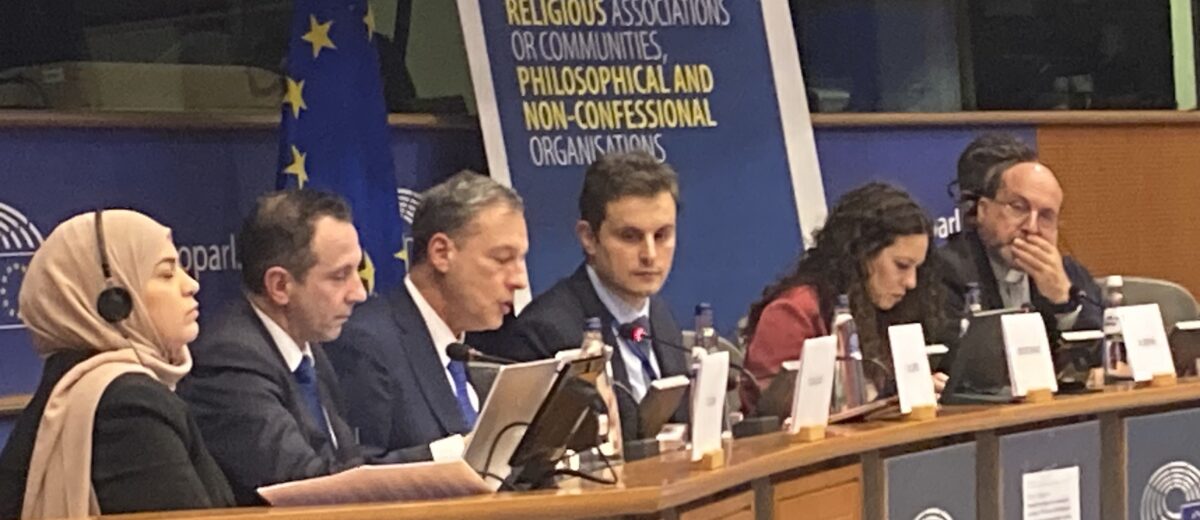
The other was expressed in the dialogue seminar I attended on Tuesday in the European Parliament building in Brussels when representatives of churches, religious and philosophical organisations interacted with representatives of the European Union institutions: Parliament, Commission and Council. This event was part of a regular series guaranteed by Article 17 of the Lisbon Treaty, committing European institutions to ‘open, transparent and regular dialogue’ with churches, religious communities and philosophical organisations.
As part of a three-member Together for Europe delegation, I was participating along with others from Catholic, Protestant, Orthodox, Jewish, Muslim, humanist and secular traditions. The subject of dialogue was ‘Measuring what matters – ethics as a compass for EU budget priorities’.
As I listened to the clear and repeated calls for the EU budget – of some €1.8 trillion for 2028-2034 – to be guided by the values of human dignity, equality, solidarity and inclusion, I found myself firstly wishing that all Europeans could witness what I was witnessing. As speaker after speaker talked of a budget guided by justice, social cohesion and care for the vulnerable, I then began wishing all Americans could hear this too.
While many Christians protested the absence of any mention of God in the draft EU Constitution back in the early 2000s, few are aware that Article 17 of the Lisbon Treaty required the EU institutions regularly to recognise churches and religious communities not as private clubs but as contributors to Europe’s public life, and guarantee them a channel of access to policymakers.
Dialogue, not domination
Article 17 represents a Europe of pluralism, dialogue, and shared responsibility. The spirit is not nostalgic but collaborative. Enshrining freedom of conscience, it reflects a vision of Europe as a community of diverse traditions, each bringing moral, social, and spiritual resources to the common good. It embodies the idea that dialogue, not domination by any one tradition, is the path toward social cohesion. And it affirms that Europe’s identity is not fixed in stone but is continually shaped through conversation among its peoples.
Article 17, in other words, presumes confidence rather than fear. It assumes Europe can handle its own diversity, listen across differences, and still find common ground.
The US National Security Strategy announced on Friday imagines Europe very differently. In stark contrast, it warns that Europe is undergoing ‘civilisational erasure’. Population decline, migration, weakened national sovereignty and supranational institutions are described as forces making Europe ‘unrecognisable within a generation’. It echoes manifestoes of extreme-right parties in Europe. It plays on the politics of fear and identity, ominously urging ‘aligned countries’ to restore Europe’s ‘traditional identity’. European leaders have rightly responded that it smacks of racism, white supremacy and xenophobia. And forebodes future American interference in European elections.
Where Article 17 sees dialogue and pluralism as part of Europe’s democratic fabric, the US strategy sees it as distraction, a threat to survival. Where Article 17 provides structured space for cooperation between institutions and communities, the US approach frames culture as a battlefield in which Europe must defend a supposedly fragile civilisational core.
Different futures
The difference in tone is not merely rhetorical: it reflects two competing worldviews and implies different futures for Europe. One sees Europe’s identity as evolving and shared; the other sees it as fixed and under siege.
Article 17 strengthens the EU’s capacity to integrate complexity. It provides a space where moral perspectives—on migration, artificial intelligence, family policy, social cohesion, climate responsibility—can be expressed without turning politics into culture war. It protects the independence of Europe’s diverse church–state arrangements. And it affirms that faith communities can contribute constructively to a liberal democratic order.
The US strategy, by contrast, risks fuelling fragmentation. Its warnings of cultural decline echo themes long used by nationalist, populist and identitarian movements across the continent. The result could be a more polarised continent, more suspicious of difference, and less capable of the kind of dialogue Article 17 envisions.
Most ominously, the US strategy signals that Europe faces major challenges – war, demographic change, political extremism, economic uncertainty, and social fragmentation – without the US as an ally. In a radical break from American policy since WW2, the US can no longer be relied on as a champion of the four freedoms declared by President Roosevelt: of worship, of speech, from want and from fear. It stirs major questions about America’s future.
In fact, the enormity of this Security Strategy is that – if unchecked – it will signal the end not only of the ‘land of the free’ we all grew up with, but the international-rule-of-law world order, NATO and the UN as we know it. It reads like a script dictated from the Kremlin, just like the 28-point so-called ‘Peace Plan’. It will polarise the world into a ‘values’ bloc and a ‘power’ bloc.
It could one day be seen as the greatest blunder in American foreign policy since Vietnam. If not ever.

Till next week,