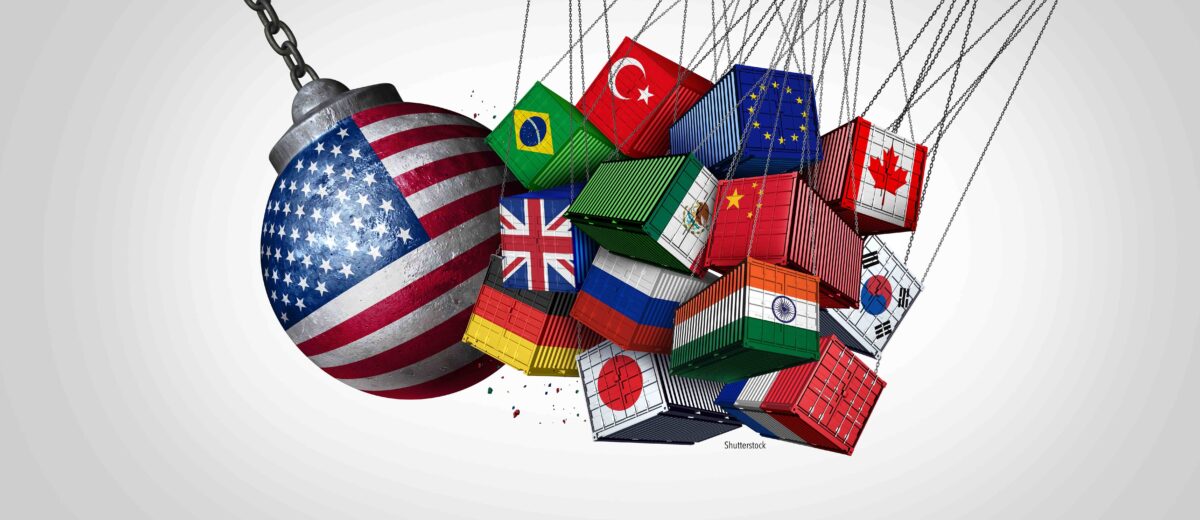
The emergence of an isolationist-yet-imperial United States under a fascist and autocratic administration is not as ‘unAmerican’ as we might like to think.
All our lives we have only ever known a relatively stable-albeit-imperfect pax americana based on respect for international law, sovereignty of nations, multilateralism, human rights and democracy. We have never experienced the unabashed, bullying, xenophobic, mafia-style behaviour of an American president before.
Yet prior to World War Two, we can discover a long undercurrent of isolationism, antisemitism, fascist and authoritarian tendencies that helps explain the choice of many Americans for their current leader.
Likewise, European appeasement towards the bellicose behaviour of the erstwhile ‘leader of the free world’, as well as to Kremlin aggression over the past decade or two, also has precedence in the twentieth century.
For the catastrophe of the Second World War did not arise solely from the ambitions of Adolf Hitler and the Nazi regime; but also from a wider moral and political failure across democratic societies in Europe and the United States.
American isolationism and European appeasement created the permissive environment in which Nazism flourished. Though shaped by distinct historical experiences, both shared a common logic: the desire to avoid conflict at almost any cost, even when the cost was justice, truth, and human lives.
Fear of Entanglement
American isolationism in the interwar period had deep roots. From George Washington’s warning against ‘entangling alliances’ to the trauma of the First World War, many Americans concluded that involvement in European affairs brought only death and disillusionment. By the 1930s, this sentiment had hardened into a political orthodoxy. Congress passed a series of Neutrality Acts designed to keep the United States out of foreign wars. Public opinion overwhelmingly opposed intervention in Europe. “America First” is not a recent innovation. It was the rallying cry of the America First Committee (AFC), founded in September 1940, as Europe was already engulfed in war. Its core belief was simple: The United States should stay out of foreign wars, especially the war in Europe.
Many isolationists sincerely believed they were preserving peace and democracy. Yet the effect was to paralyse moral judgment. German rearmament, the remilitarisation of the Rhineland, the Anschluss with Austria, and the dismemberment of Czechoslovakia were widely viewed as regrettable but not America’s concern. Europe’s crises were seen as cyclical and self-inflicted. Distance provided safety.
This detachment proved illusory. Pearl Harbour sank the America First movement overnight.
Compounding isolationism was a pervasive antisemitism within American society. Perhaps less violent than in Europe, it was nevertheless socially acceptable and institutionally entrenched. Jewish quotas in elite universities, housing discrimination, exclusion from professions, and conspiracy theories about Jewish power were commonplace. Jews were seen as foreign, destabilising, or likely to provoke domestic unrest.
Despite mounting evidence of Nazi persecution, the refusal to admit Jewish refugees—symbolised by the 1939 turning away of the MS St. Louis— reflected widespread public hostility. As a result, the suffering of Europe’s Jews failed to generate the urgency it demanded.
High-profile Nazi-sympathisers lent cultural legitimacy to authoritarian rhetoric and helped fuse isolationism with conspiracy thinking and ethnic scapegoating. The popular aviation pioneer Charles Lindbergh blamed ‘the British, the Jews and the Roosevelt administration’ for pushing the nation toward war. A 1939 rally in Madison Square Garden attended by 20,000 featured Nazi-salutes and displayed portraits of George Washington flanked by fascist symbols, swastikas and American flags. ‘Influencer-priest’ Father Charles Coughlin broadcast antisemitic and authoritarian propaganda to millions. Henry Ford was a brazen Nazi sympathiser whom Hitler explicitly praised in Mein Kampf and whose portrait hung in the führer’s office.
The Illusion of Peace
Across the Atlantic, European leaders faced a different but parallel dilemma. Britain and France, devastated by World War I, pursued appeasement in the hope of preventing another continental catastrophe. After the Munich Agreement of 1938, which sacrificed Czechoslovakia to Hitler’s demands, Prime Minister Neville Chamberlain returned proclaiming ‘peace for our time’, reflecting a widespread longing for stability.
Appeasement, like American isolationism, was driven by fear, exhaustion, and a desire to protect domestic order. Yet it rested on a fatal misreading of Nazism. Hitler’s ambitions were not limited or negotiable; each concession merely confirmed his belief that democracies lacked the will to resist. Appeasement did not prevent war—it postponed it while strengthening the aggressor.
American isolationism and European appeasement shared a common moral logic. Both treated aggression as a regrettable but manageable problem. Both prioritised short-term peace over long-term justice. Both underestimated the ideological nature of Nazism and overestimated the power of restraint in the face of radical evil.
Most tragically, both failed Europe’s Jews. The reluctance to confront persecution sent a clear message: Jewish lives were negotiable in the pursuit of stability.
The eventual American entry into the war and the Allied victory should not obscure the lesson of the 1930s. Democracies do not fail only through collapse or conquest; they fail through delay, denial, and moral equivocation. The language of neutrality, national interest, and peace can become tools of self-deception when severed from justice.
The tragedy of the 1930s was not simply that evil existed, but that it was recognised—and yet tolerated—for far too long.
P.S. For New Zealand readers: I am presently visiting family and friends in my motherland and have been invited to address a public meeting on Sunday, February 1, 6-8pm, at Holy Trinity Anglican Church, Tauranga, on the topic: ‘how should followers of Jesus respond in a time of political turmoil and cultural fragmentation?’ All welcome.
Till next week,

Hi Jeff, I think you are misreading the present situation in Europe and America. Trump is pushing the Western world to re think its failed policies and re-establish national sovereignity and proper borders and re-align to Judeo-Christian values. Trump’s whole approach is challenging the leftish ideology and it twin sister Wokism and stopping the rise of Islam by supporting Israel the only nation who truly understands the importance of fighting the globalist agenda of Islam. He is joined by Javier Milei the Argentininan President and the Polish President who understand that the European Union is collapsing.
d5dw6w