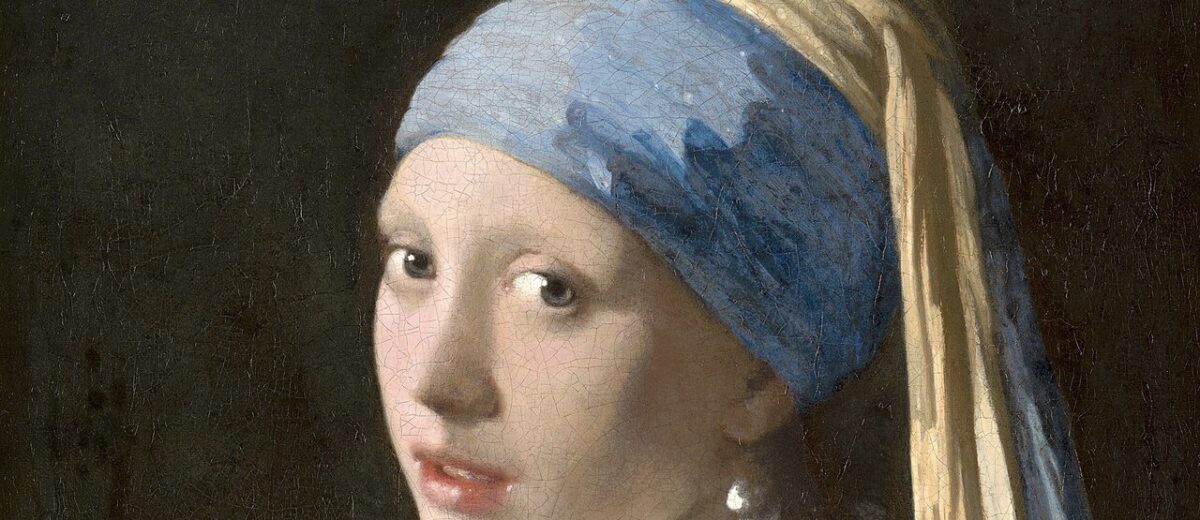
(this time hopefully with the photo!)
Recently I mentioned fresh insights on the work of the 17th century Dutch painter, Johannes Vermeer, brought to light recently by a BBC art documentary maker, Andrew Graham-Dixon.
His newly-published book, Vermeer: A Life Lost and Found, offers a totally new interpretation of the spiritual meanings of the popular Dutch painter’s work, including Girl with a Pearl Earring, The Milkmaid and View of Delft.
For much of the two centuries following his death in 1675, Johannes Vermeer was effectively a forgotten artist. He left behind a small body of work—little more than thirty known paintings—and during his lifetime he was respected locally but never widely famous. After his death, his name faded quickly. It was not until the nineteenth century that Vermeer was rediscovered and recognized as a singular genius.
His discoverer, the French critic Théophile Thoré-Bürger, called Vermeer ‘the Sphinx of Delft’ because of the mystery that surrounded both his life and his art. He left no letters, diaries or notes about his works. We know almost nothing about his artistic intentions, his training or how he achieved his extraordinary effects of light and color.
Vermeer’s figures, mainly women, are absorbed, silent and contemplative. Like a sphinx, the paintings pose questions rather than provide answers. The viewer is invited to look, to wait, and to interpret, but never to fully resolve their meaning.
Girl with a Pearl Earring (c. 1665), for example, has long been admired for its quiet intimacy and haunting ambiguity. Often described as the ‘Mona Lisa of the North’, the painting appears at first glance to be a simple image: a young girl turns her head, lips parted, eyes luminous, a single pearl catching the light. For generations of viewers and scholars, its power has lain precisely in its mystery.
Fringes
Graham-Dixon offers a strikingly different way of understanding the painting, rooted in Vermeer’s personal circumstances and the religious culture of seventeenth-century Delft. He suggests that the girl is a real person: Magdalena van Ruijven, the young daughter of Vermeer’s principal patrons, Pieter van Ruijven and Maria de Knuijt. The Van Ruijven family, who commissioned and owned many of his works, enjoyed a close and sustained relationship with Vermeer. They were linked with a movement on the fringes of the Remonstrant brotherhood, followers of Jacob Arminius, shunned by Calvinists for their belief in human free will.
The author explains how he came to his conclusions here (or in more detail here), through painstaking research in archives in Delft, the city where Vermeer lived and worked. He unravels a complex religious landscape in which the artist appears to have converted to Catholicism upon marriage, yet lived and worked among members of Remonstrant circles, including the fringe Collegiants.
The Collegiants believed that truth was revealed through inner illumination rather than clerical authority. They shunned church buildings and liturgies, meeting in private homes. Women were encouraged to speak, expound Scripture and share spiritual insight alongside men. These communities emphasised personal religious experience over dogma, inward illumination over outward display. According to Graham-Dixon, this ethos shaped Vermeer’s art profoundly, infusing even his most apparently secular works with spiritual resonance.
Women play a disproportionate role in Vermeer’s work, he points out, not as passive, decorative or morally suspect figures, but absorbed, attentive and alert to meaning. This reflects the place of women in the gospel narratives: Jesus’ friendship with Mary and Martha, for example, and his choice to first reveal himself after the resurrection to Mary Magdelene, who then was entrusted with the responsibility to tell the others.
Surprise
For the Collegiants, Mary Magdelene was an important justification for the ministry of women. The fact that Vermeer’s friend had named their daughter Magdelena was further evidence of their esteem for their biblical model.
From this perspective, Girl with a Pearl Earring can be read not just as a portrait, but as a visual meditation. Graham-Dixon proposes that the girl is dressed in what contemporaries understood to be biblical garb, and represents Mary Magdelene glancing over her shoulder at the very moment that she perceives the divine presence before her: the resurrected Christ. Vermeer thus captures a fleeting instant of awareness: surprise, awakening and inner transformation. This is the moment when the first human recognises the risen Christ!
The girl’s parted lips and alert gaze suggest not seduction or flirtation, but the dawning of understanding – as if she has just been called by name: ‘Mary!’
In this symbolic reading, the pearl itself becomes a metaphor for spiritual insight, the pearl of great price (Matthew 13:45–46), the Kingdom of Heaven. Vermeer has Mary looking straight at the viewer who thus stands in the place of Jesus himself, inviting the viewer to ask, ‘how Christ-like am I truly?’
For Graham-Dixon, this is consistent with the spirituality of the Collegiants. The painting does not merely depict contemplation. It invites it.
Till next week,