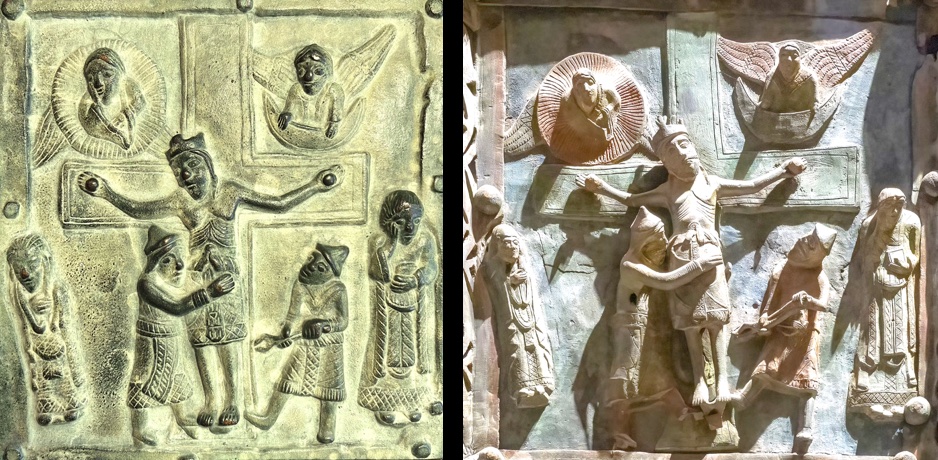
A 12th century bronze Romanesque copy of a plaque from a church door in Verona, Italy, became a source of inspiration and understanding during our recent trip to Ukraine.
The day before Romkje and I left for Ukraine, two weeks ago today, we joined a Benelux gathering of Together for Europe in Aachen, Germany. Our host, Klaus Henning, first suggested the group pray for us. Then he produced a bronze replica of the Verona plaque, and asked us to take it to Ukraine – and back again.
What we were to do with the plaque (left in photo) was not immediately clear to me. However, as I researched its source, the San Zeno Church door where the more detailed original (right in photo) is still on display, I began to see it as containing both a prayer guide and a prophetic statement about Ukraine’s suffering.
Such medieval ‘stone (bronze) sermons’ were intended to teach the illiterate faithful how to read history through the lens of faith. Here the Crucifixion with Christ standing upright upon the cross, suffering but not broken. He is not merely a victim but a victorious king, his crown of thorns now a crown of royal authority. Around him gather a handful of figures: Mary in grief (left), John in solemn witness (right); and two figures I first read as soldiers but later came to another interpretation. Above, the sun and moon testify that this is no private tragedy but a cosmic turning point. Angels signal the eclipse of the sun at Jesus’ moment of death, one before the sun and another covering the moon.
As Ukraine endures the anguish of invasion and war, this ancient plaque speaks again with surprising relevance. It offers a visual theology of suffering, responsibility, conversion and hope — themes that illuminate the moral authority Ukraine is quietly earning before the conscience of the world. As we visited various YWAM centres, we shared our understanding and prayed accordingly.
Shared dignity
Mary represents the bereaved, the wounded, the vulnerable, the tears of mothers, the displacement of families, the trauma of children, the elderly waiting in cold apartments without power or certainty. Prayer for Ukraine is to intercede for refugees, for the traumatised, for those who mourn.
Next stands John, the disciple entrusted with social responsibility at the foot of the cross. In the Gospel narrative, Jesus gives Mary into John’s care. In that moment, the church is born as a community of practical love, willing to organise, shelter, advocate and rebuild. In the Ukrainian context, the role of John is visible in faith communities that have become centres of humanitarian relief, spiritual resilience and moral witness. Prayer for Ukraine includes asking that Christian communities, both within Ukraine and across Europe, will serve the suffering and speak truth in public life.
Below the cross are what I understood to be the soldiers. One with the spear that pierced Christ’s side, identified by tradition as Longinus, a half-blind soldier whose eyes were healed at the crucifixion. Another embracing Jesus perhaps represented the centurion who exclaimed: ‘Surely this was the Son of God’. Ukraine’s struggle involves soldiers on both sides: defenders and aggressors. Prayer for Ukraine also includes asking that those bearing arms will not lose their humanity, and that eyes will be opened to the reality of shared dignity.
Hidden strength
Valid prayer points in themselves. But closer inspection of the original panel on our return revealed that these figures were Joseph of Arimathea and Nicodemus (with pincers, not a spear) coming to take Jesus’ body down. Both important civic leaders, they can point us to pray for those with influence to act with integrity, to resist corruption and complicity, to speak truth and to pursue justice. And also to pray for those who recover bodies, document war crimes, bury the dead with dignity, care for the wounded and traumatised in the aftermath of battle.
Finally, the plaque reminds us that, as the suffering of the Crucifixion has cosmic dimensions, so Ukraine’s ordeal is not merely a regional conflict. Ukrainians are defending justice, sovereignty, truth and the future of the international order. The Romanesque plaque from Verona captures a paradox in bronze: apparent weakness revealing hidden strength, violence confronted by steadfast love, history opened toward redemption.
To contemplate this image today is to be invited into prayer that is both tender and expansive:
• We pray through Mary’s eyes for the vulnerable.
• We pray with John’s perspective for responsible, united and compassionate faith communities.
• We pray for soldiers that their eyes may be opened.
• We pray for the influential to stand for justice, integrity, truth and freedom.
• And we pray that the struggle of Ukraine will lead to justice freedom and moral clarity, also in Europe and beyond.
P.S.
Join others from various faith communities standing in moral solidarity with Ukraine in the next 24@7 Prayer Zoom, Tuesday, 24 March, 7pm Kyiv time, 6pm CET.
You can use this link:http://tiny.cc/24at7 or this QR:
Till next week,