What does our volatile world most urgently require: re-armament or moral re-armament?
Russia’s full-scale invasion of Ukraine under Vladimir Putin has shattered illusions that major war on European soil belonged to the past. Across Europe, defence budgets are rising sharply. Poland is expanding its armed forces at remarkable speed and announced plans this week to develop a nuclear deterrent.
With sinking hearts we watched last weekend the unleashing of lethal military power on Iran in disregard of all international legal principles and American constitutional law, thus further dismantling the post-war international order set up to prevent global war.
In a ‘might is right’ climate, calls for re-armament are not warmongering; they are often expressions of responsibility. Sadly, when both Moscow and Washington talk ‘peace’ but do war, and trust between allies has been eroded by bellicose behaviour, we have a new reality to face.
Ukraine has survived not on speeches but on artillery, air defence systems and the courage of its soldiers. A credible capacity to deter aggression protects the vulnerable and may prevent wider war. As Robert Schuman understood in the aftermath of World War II, peace requires structures strong enough to resist the return of violence.
Moral crisis
Yet even as military preparedness increases, there is a growing sense that our crisis is not only geopolitical but moral.
Weapons can defend borders… but not truth. Missiles can deter invasion… but cannot create trust. Armies can protect sovereignty… but cannot restore virtue.
This week, in an Article 17 dialogue in the European Parliament promoting partnering between politicians and faith leaders, I quoted the leading Ukrainian churchman of last century, Andrey Sheptytsky: “The measure of a nation’s strength is the moral strength of its people”.
Europe before 1914 was heavily armed and economically interdependent. None of that prevented catastrophe. The deeper failure lay in moral imagination: the inability of leaders to restrain nationalist passions, to resist the momentum of pride and to remember the human cost of total war.
Today’s volatility has similar moral dimensions. Public discourse is corroded by disinformation and propaganda. Democratic institutions are treated with cynicism. Religion is instrumentalised for nationalist ends. History is manipulated. The memory of commitment to ‘never again’ has faded.
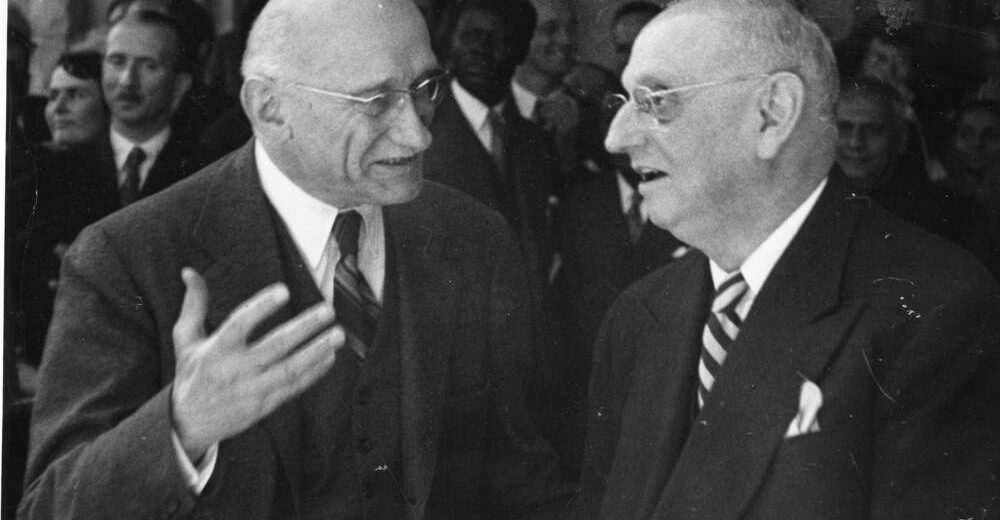
This is why the language of ‘moral re-armament’ deserves renewed attention. The phrase is associated with the interwar and postwar movement Moral Re-Armament, today known as Initiatives of Change. Its founder, the American Lutheran evangelist Frank Buchman, promoted a ‘hate-free, fear-free, greed-free world’ through personal moral transformation through commitment to four absolute moral standards—honesty, purity, unselfishness and love. Robert Schuman was influenced by Buchman’s message (they met several times, as in the photo above in Caux, Switzerland).
Moral re-armament today would mean:
• First, a renewed commitment to truthfulness in public life. Democracies cannot survive if citizens no longer trust what they hear. Disinformation—whether from Moscow, Beijing, Washington or home-grown populists—erodes the very ground on which freedom stands.
• Second, a re-focusing on human dignity. The language of human rights emerged from the ashes of war, grounded in the conviction that every person, created in God’s image, bears inherent worth. When refugees become bargaining chips or civilian casualties are dismissed as collateral damage, we are losing our moral bearings.
• Third, courageous leadership. The founders of postwar Europe – Schuman, Adenauer and De Gasperi—understood that reconciliation required moral courage. Their project was not merely institutional but ethical. Today Zelensky, Carney (Canada) and Stubb (Finland) courageously speak truth to autocrats.
• Fourth, repentance where necessary. Western democracies are not immune to hypocrisy. When Christian or democratic communities trade principle for power, or turn a blind eye to injustice because it serves short-term interests, credibility drains away. Moral re-armament begins with honest self-examination.
None of this negates the need for defence. In fact, the choice between re-armament and moral re-armament is a false one. The real question is one of order and priority.
Arms without moral clarity become instruments of domination. History offers abundant examples of powerful states that lost their moral compass and thereby destabilised the very order they claimed to defend. On the other hand, moral aspiration without the capacity to defend the vulnerable becomes helpless idealism. Appeals to international law cannot stop tanks without the means to enforce that law.
The post-1945 European settlement has held these realities together – until now. NATO provided security; the European project fostered reconciliation and shared prosperity. But both were animated by a moral vision shaped by the memory of catastrophe and by a belief in human dignity.
Today, we risk preserving the hardware of security while neglecting its moral software. Defence spending may increase even as public trust declines. Armies may grow even as shared values erode. That imbalance would prove dangerous.
So what is needed most? In the short term, sufficient re-armament to deter aggression and defend those under attack.
In the long term, and ultimately more decisively, moral re-armament: a renewal of truthfulness, responsibility, courage and respect for human dignity.
Till next week,