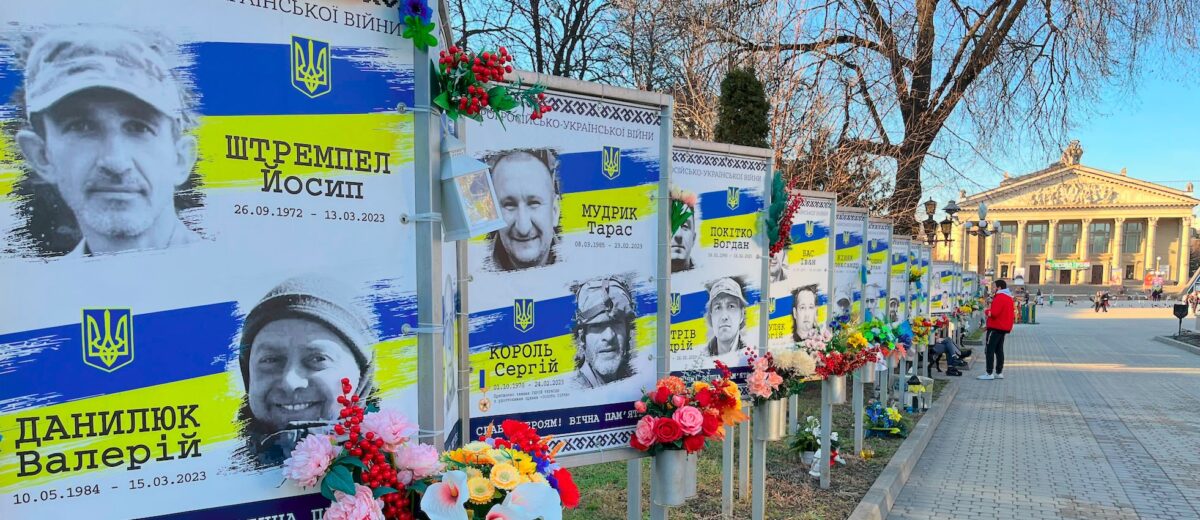
Russia’s ruthless invasion of Ukraine has confronted Ukrainian Christians with some hard moral questions.
Halfway through an eight-day visit to Ukraine to encourage YWAM workers and other believers with colleagues Dick and Ulla Brouwer, Romkje and I are being made aware of how much we Europeans are indebted to the sacrifices, the resilience and the commitment of Ukrainians.
In conversations with pastors, theologians, historians, soldiers, chaplains, educators, bereaved family members and ‘ordinary’ believers, we are hearing Ukrainians wrestling with issues that many Western Christians have long discussed only in theory.
Should believers remain pacifists when their cities are bombed? When defending families and freedom requires force, what does faithfulness to Christ look like? How should churches relate to political power?
Innovation, humour, solidarity and doggedness have helped the nation emerge from the cruel attacks and the biting cold winter far from cowed and broken. In fact, the reality is that a Ukraine under oppression is becoming a world leader on several fronts: military innovation, digital governance, civic mobilisation and societal resilience. Ukraine is not only defending itself—it is helping to redefine how nations survive and adapt in the turbulent politics of the 21st century.
Most importantly, Ukraine is becoming a laboratory of ethics for the global church. One influential voice in this discussion is historian Yaroslav Hrytsak (see my interview with Yaroslav here). His central claim is that absolute pacifism can become morally irresponsible in the face of violent tyranny.
Peace is the ultimate goal of any moral society, Hrytsak affirms. But that peace must not be confused with passivity. When a powerful aggressor seeks to destroy a nation and erase its identity, refusing to resist may actually enable greater injustice.
Hrytsak frames the war not primarily as a nationalist struggle but as a defence of moral order itself. Ukraine, he argues, is resisting a system built on lies, repression and imperial domination led by Vladimir Putin. If such aggression succeeds, it does not merely harm Ukraine; it undermines the principle that truth and freedom matter in international life.
Ukraine is therefore on the frontline of the battle for the soul of Europe – and of the West.
Sacrificial protection
The question is no longer simply, ‘Is violence wrong?’ Rather it becomes: ‘what responsibility do we bear toward those who are vulnerable to violence?’
From this perspective, refusing to defend civilians may itself be a form of moral failure. A society that abandons its citizens to brutality in the name of moral purity risks turning peace into a form of indifference.
This argument resonates deeply with many Ukrainian Christians. Until now some Protestant communities had pacifist leanings, influenced by Anabaptist traditions and life under Soviet militarism. But the reality of invasion has forced a re-examination.
Many believers now describe military service as an act of sacrificial protection rather than nationalist aggression, quoting Jesus in John 15:13: ‘Greater love has no one than this: to lay down one’s life for one’s friends’.
Yet most Ukrainian churches avoid condemning those who remain pacifists. Instead, a broad moral consensus has emerged: some Christians defend the nation through military service, while others serve through chaplaincy, humanitarian aid and care for refugees, widows and veterans. Both forms of service are understood as expressions of love for neighbour.
Cautionary lesson
The war has also reinforced a crucial principle for Ukrainian Christians: the church must never become the servant of political ideology. They are keenly aware how religious language can be manipulated to justify imperial ambition. Both Putin and the leader of the Russian Orthodox Church, Patriarch Kirill of Moscow, frame Russia’s war as a defence of a sacred Christian civilisation. Theologians worldwide–Orthodox, Catholic and Protestant–warn against this dangerous fusion of nationalism and faith, whether expressed as Russky Mir or American Christian nationalism.
Ukraine’s experience offers a cautionary lesson. When Christianity becomes indentified with a political project, it loses its prophetic voice. Instead of challenging power, it sanctifies it.
Yet the Ukrainian story also carries a message of hope. Churches and Christian organisations across the country have become centres of extraordinary civic service. Believers have organised refugee shelters, medical assistance, trauma counselling and humanitarian relief on a massive scale. Faith has moved beyond private spirituality into public responsibility.
This may be the deepest insight emerging from Ukraine’s laboratory of ethics. Christian faith is not simply about maintaining moral purity or winning political arguments. It is about responsible love in the real world, even when the choices are painful and imperfect.
In the end, Ukrainian Christians are reminding the global church of a difficult truth. Peace is not merely the absence of conflict. It is the presence of justice, truth and the protection of the vulnerable.
Even in the midst of turbulence.
Till next week,

Jeff, myself and YWAM Kyiv community so grateful for your visit and the way you have been not only advocating for Ukraine but for truth and justice.
We have been enjoying every moment with you and have been thinking of words you left for us as encouragement. Each one speaks deeply to our situation and personal walk during this season.
Thank you and hope to see you in Ukraine again!