We are recalibrating in the Schuman Centre.
We want to focus more on a question we have often raised but are not yet satisfied with our answers. Robert Schuman was adamant about it. Jacques Delors was insistent about it. And now, Ukraine is making the question unavoidable.
What do we mean by ‘the soul of Europe’, and how can it be resuscitated?
Since 2011, we have organised the State of Europe Forum around Europe Day, in the capital of the country holding the EU presidency. That stretched into quite a long list: Budapest, Copenhagen, Dublin, Athens, Riga, Amsterdam, Valetta, Bucharest, Helsinki, Paris, Stockholm, Brussels and Warsaw.
Each year that has meant repeated trips to the relevant city, meetings with church leaders and believers in the public square to encourage them to explore what contribution they can make during the presidency. Our question has been how as Christians we should respond to the current state of Europe in the light of Schuman’s vision for ‘a community of peoples deeply rooted in basic Christian values’.
Cyprus presently holds the presidency of the European Union, which would normally mean that we should be preparing for a State of Europe Forum there in May.
However, we have sensed a fine tuning for the Schuman Centre, a shift from response to formation, reactive to proactive, from analysing Europe’s condition to investing in its renewal. We have tried to respond to present realities and challenges. This has been valuable. But it is no longer sufficient.
A reactive approach focuses on symptoms rather than sources. Europe’s challenges are not only political or economic; they are deeply cultural and spiritual. Beneath the visible crises lies a more profound one: a loss of soul.
Decisive moment
Europe stands again at a decisive moment. War has returned to our continent. Borders are contested. Truth is manipulated. Power is exercised without restraint. Democracy is fragile. Society is fragmented. A growing sense of civilisational fatigue demands attention. In the midst of this upheaval, a question rises that is deeper than strategy or sanctions: What sustains a nation or a community of nations when everything material is under assault?
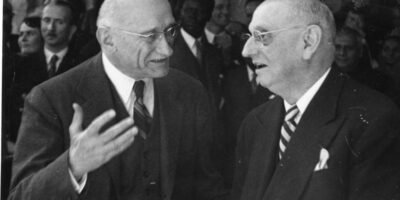
Schuman understood that Europe’s future required more than the emptiness of technocratic materialism. It required a shared moral imagination. It needed a soul. Delors urged religious leaders to help find a soul for Europe, without which, he warned, the game would be over within a decade. A devout Catholic like Schuman, Delors clarified that by ‘soul’ he meant ‘spirituality and meaning’.
Their pleas however fell largely on spiritually tone-deaf ears. Most politicians in the last quarter of last century, were – as now – biblically illiterate. Few understood what these men were talking about. For most, the European project was simply an economic experiment. Lip service was offered to Europe as a moral commonwealth, a values-based community. But without a heart-commitment to the transcendent source of truth, life and values, high ideals easily become self-interest when tested. What sustains a nation or a community of nations when everything material is under assault?
We are now way past Delors’ deadline, and the appeal is as urgent as ever. Europe is once again being tested — not only militarily or economically, but morally.
And Ukraine is refocusing the attention of Europe’s leaders. Ukrainians have been insisting for years now that they are fighting not only for their own freedom, but for the future of Europe. Slowly, like waking from a deep stupor, we Europeans are beginning to realise our grave danger.
Ukraine today is not only a battlefield. It is a laboratory — for reshaping the soul of a nation. And perhaps, for Europe as a whole.
When the full-scale invasion began four years ago last week, many analysts predicted a swift collapse. Ukraine was assessed in terms of military capacity, GDP, political fragmentation. But nations are not sustained by metrics alone. Ukraine did not collapse because something deeper held. Leadership showed moral courage. Volunteers mobilised overnight. Churches opened as shelters. Civil society networks organised humanitarian corridors. Ordinary citizens displayed extraordinary courage. Across denominational and linguistic lines, a renewed sense of belonging emerged.
Moral capital
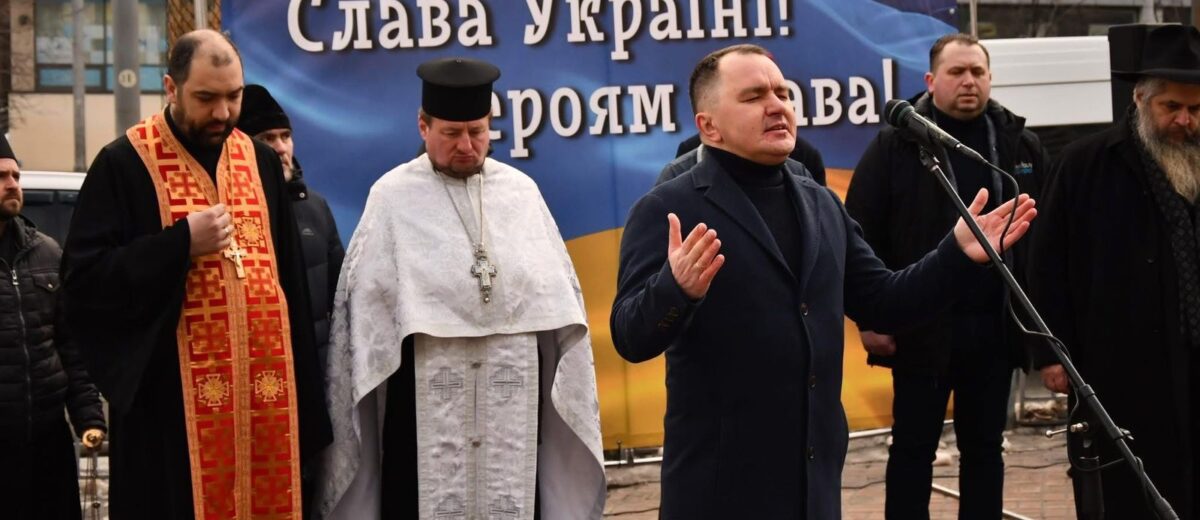
A nation survives when it possesses moral capital — shared convictions about dignity, responsibility and solidarity. Ukraine discovered under fire that its identity was grounded in a commitment to freedom, to human dignity, and to democratic choice. Prayer events across the nation last Tuesday, the fourth anniversary of the Russian invasion, revealed a wide and deep awareness of national dependence on God (see photo where Pentecostal leader Yuriy Kulakevych prays with other churchmen).
That rediscovery is reshaping the national soul. Out of her suffering has emerged a remarkable search for moral renewal. The ideals expressed during the Maidan Revolutions of dignity, justice and freedom reflect a deep moral and spiritual impulse. I know of no other country where there is such respect for the churches as trusted moral actors shaping society. Ukrainian leaders I personally know have been inspired by the Schuman story of post-war forgiveness and reconciliation to propose a grass-roots, civil society initiative for the survival and transformation of their country, rooted in spiritual and moral foundations.
The idea of the ‘soul of Europe’ is not nostalgic rhetoric. Europe was shaped by a vision of human dignity, community, and transcendence, deeply influenced by the Christian story. Over time, that deeper vision has faded. In its place, Europe often relies on procedural unity and a thin language of values detached from their roots. This leaves Europe struggling to explain itself, inspire its citizens, or sustain its commitments under pressure.
This is why recalibration is needed. Europe today lacks a shared narrative strong enough to bind diverse peoples together. Recovering the soul of Europe begins with memory: remembering the sources of its ideals—human dignity, justice, reconciliation, and care for the vulnerable. But it also requires imagination: re-articulating these foundations in ways that speak to a new generation.
Europe’s future will not be secured by fear, but by rediscovered meaning. To honour Schuman’s legacy is to recognise that Europe is ultimately a moral and spiritual project.
What will this mean for future Schuman Centre activities?
Not everything is crystal clear, apart from there being no State of Europe Forum in Cyprus this May. But here is a sampler:
- This coming Tuesday, March 3, I will represent the Together for Europe network in the European Parliament as a panelist in an Article 17 dialogue between politicians and faith leaders on partnering towards a Europe with stronger spiritual and moral foundations.
- Romkje and I visit YWAM centres in Ukraine with Dick and Ulla Brouwer (March 8-17) and plan a live Schuman Talk from Lviv on March 9, 6pm CET with academics on Ukraine’s role in reviving Europe’s soul. (Details next week).
- We will be partnering with Together for Europe in a three-day event in Brussels and the European Parliament, May 11-13: Reviving Europe: a soul for reconciliation – details to come.
- Engaging the world summer school, Amsterdam – with three modules:
- July 13-17, engaging the city; July 20-24, engaging the public square; July 27-31, engaging Europe.
Till next week,