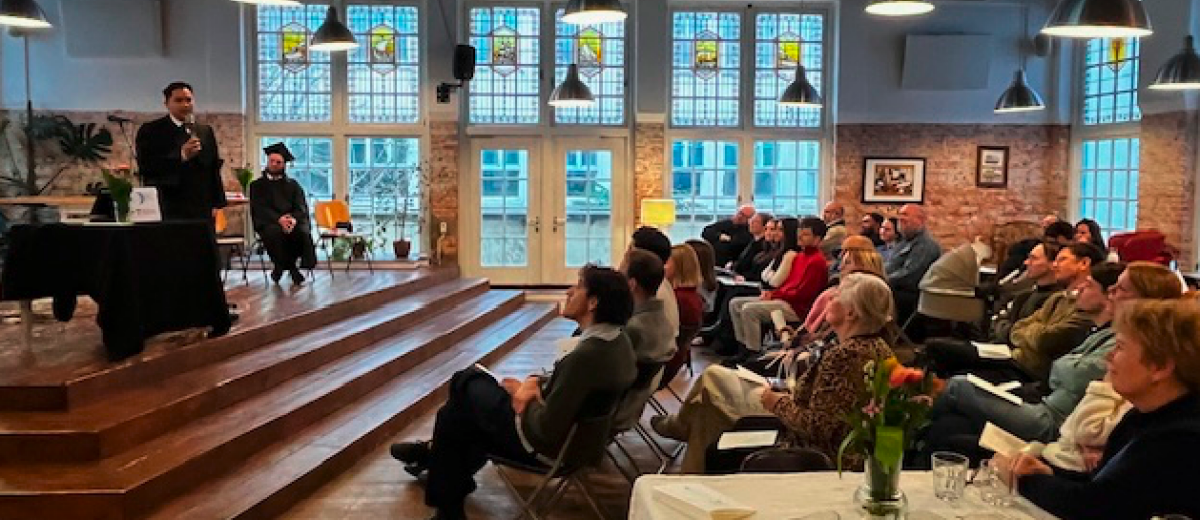
Against a background of rapidly deteriorating international relations this week, we held a graduation ceremony in Amsterdam for two Schuman Centre masters degree graduates in Missional Leadership and European Studies.
We reflected with the family, friends and colleagues of the graduates on why we should study at all, on what ‘missional’ meant, and on why we should study ‘Europe’. The two graduates shared about their research and possible implications for YWAM.
The ceremony also marked the closure of a seven-year partnership with ForMission College and Newman University, both in Birmingham, through whom the degrees were granted under the Bologna process of higher education in Europe. Given declining student numbers and increasing costs, ForMission unfortunately has had to discontinue after forty-five years. Most students have been transferred to the Moorlands College Campus near Christchurch in southern England.
I am grateful to the ForMission staff for enabling us to offer these masters programmes over the years. We are pursuing a new academic framework to continue our masters programme and hope to be able to make an announcement soon.
Why study?
But why study in the first place? In evangelical and pentecostal circles, YWAM’s main constituency, there is still a lingering anti-intellectual attitude. I once received advice from a pentecostal pastor when I was a student: ‘Don’t get intellectually handicapped’. He meant: ‘just believe, brother!’
Study is part of loving God with all our minds. It involves studying both God’s book of words and his book of works. It is a disciplined search for truth in a world marked by confusion, distortion and power without accountability. It is how we learn to discern reality accurately, and to act wisely, proactively rather than reactively.
Missional?
Missional leadership engages in missio Dei, discerning what God is doing in our neighbourhood, city, nation and world. It is God-centred, not church-centred or even mission-organisation-centred. Missional leadership begins with the conviction that we are sent into a world where God is already at work—sent into the complexities of public life, culture, economics, and politics—not to dominate, but to witness, to heal, and to help order society toward the common good. Our job is to discern where he is at work and to join his ongoing work in the world.
Too often we have replaced Christianity with churchianity. Yet the essence of being a Christ-follower is not church-attendance itself. It’s following Christ into his world and obeying him. Whether in church activities or a mission organisation, we need to ask ourselves where our focus is: in building up our church or organisation, running Bible study courses and worship events? All of which is good – but is it missional? Are we engaging in missio Dei, God’s work in our neighbourhood, city or nation?
European studies?
Those of us with evangelical/pentecostal roots find it hard to think about Europe as a moral and spiritual experiment, and to discern where God may be at work. We have a tendency to think of the world out there as something to be saved from. Yet from the ruins of World War Two emerged an attempt—imperfect and fragile—to bind nations together through forgiveness and reconciliation, in justice and peace, in trust and understanding, with law rather than force, cooperation rather than conquest. That experiment is now under severe strain. Understanding Europe today demands historical awareness, spiritual discernment and moral imagination.
Europe today urgently needs our serious focus. The continent that gave birth to ideas of human dignity, rule of law, plurality and democratic restraint now struggles to remember the sources of those convictions. The crises we face—war on our borders, erosion of trust in institutions, polarisation, migration and the return of naked power politics—cannot be addressed by technical expertise alone. They demand people who will point back to those sources of life, God’s Word. Ad fontes. These crises are opportunities for the rediscovery of Europe’s soul – that which breathed life into our civilisation in the first place, the awareness that each of us is created in God’s image, and that each of us contains the spark of divine life. And that therefore we choose for solidarity, the best for the common good – not just our own tribe or nation. And we work for communities – locally and across the continent – grounded in trust, truth and justice for all.
To study, then, is to prepare oneself for responsible engagement with our world. To pursue missional leadership is to align ourselves with God’s purposes. To focus on European Studies is to concentrate on where the need is urgent. Rooted in God’s Word, aware of what he has done in the past, we focus on his purposes, anticipating what he will yet do in the future.
May your kingdom come, in Europe, as it is in heaven!
Till next week,
jnlkzs