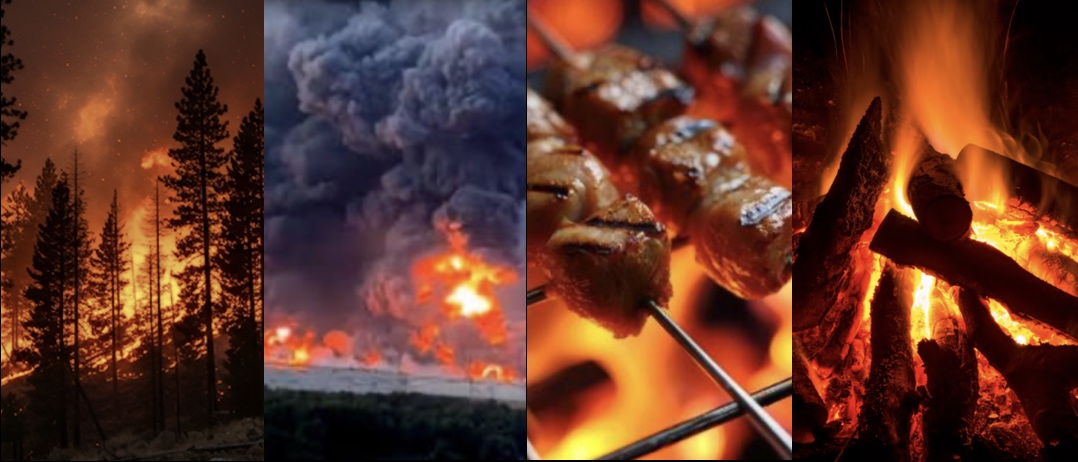
After a long, hot summer, fire fighters across Europe still desperately try to control wildfires, as well as blazing Wildberries warehouses in Moscow and burning apartment blocks in Kyiv. Meanwhile, European holidaymakers happily stir the flames of their barbecues or swap stories around campfires.
For flickering tongues of fire bring both the fearsome blaze of destruction and the comforting crackle of warmth. Fire is a constant companion in the human story: threatening, inspiring, warming, nourishing and transforming. Yet like water, air and earth, it is one of the everyday wonders we seldom pause to ponder.
Why does fire exist at all? What makes it possible? Where did it come from? How did it become central to human life and civilisation? Could life even exist without it? From the earliest human myths to the latest technological feats, fire has been one of the great forces shaping our planet — and our species.
Basically, fire is a chemical reaction — a process of combustion. When a material rich in carbon (like wood, coal, or gas) combines with oxygen in the presence of enough heat, the atoms rearrange. This produces carbon dioxide, water vapour and energy in the form of heat and light. That glow we call ‘flame’ is actually incandescent gas and vapour, radiating visible light as the molecules dance in extreme heat.
Yet scientific explanations of how fire works do not reduce its wonder. The fact that matter can suddenly erupt in light, that dead wood can blaze with heat, that something invisible like oxygen enables this drama, is truly astonishing.
Dependent on life
Fire could not exist in the early history of our planet. It requires atmospheric oxygen (to sustain combustion), dry plant material or other fuel and an ignition source (such as lightning). Only after the rise of photosynthetic life (mainly plants) did Earth’s atmosphere become rich enough in oxygen to allow fire to ignite and spread. Once these conditions aligned, lightning could strike dry vegetation, and the first wildfires would blaze across prehistoric landscapes.
So fire is a phenomenon dependent on life. It is life (plants) being consumed in a reaction made possible by life (oxygen-producing organisms). In that sense, fire is both a child of life… and its destroyer.
Fire has been a fundamental force shaping human history. The controlled use of fire was one of the great turning points in human development. Fire allowed early humans to inhabit colder climates, expanding migration across continents. Cooking with fire broke down tough fibres in plants and killed harmful bacteria in meat, making food more digestible. Fire frightened away predators and insects, creating safe zones in the dark. Fire was essential for making better tools, pottery, brick-making and metalworking. Farming on a larger scale was made possible by using fire to clear land. Fire became a centrepiece of social life. Gathering around fires for warmth and storytelling, singing, teaching and spiritual rituals became a metaphor for inspiration, spirit and knowledge. Fire extended human activity into the night with profound implications for learning, productivity and culture.
Fire helped develop our humanity. Only humans control fire – distinguishing us from the rest of the natural world. The domestication of fire was as vital as the domestication of animals, crops or language.
Wild and dangerous
Yet fire itself is not tame. It remains wild and dangerous, even as we depend on it. It can destroy just as easily as it can sustain. In the Greek myth of Prometheus, fire is stolen from the gods. It always comes at a cost. The same fire that gave us civilisation now threatens our survival. Human civilisation as we know it could not exist without fire. Everything from heat, light and cooked food to electricity, steel, transportation and communication relies on combustion or its descendants. Fire is not just useful — it is foundational to the story of humanity.
But why is fire even possible? The very existence of fire depends on the finely-tuned nature of our universe. Fire exists because atoms bond in ways that store energy in chemical form. Some reactions release energy when those bonds break or rearrange. The universe allows for unstable equilibrium: just enough energy is needed to start combustion, but once it starts, it sustains itself. Light and heat are byproducts of this process.
Which should make us ask: Why does matter behave this way? Why are we in a world where combustion is possible? and useful? Why does the human mind take interest in something as basic as a flame? and find meaning in it? Some conclude fire is an unlikely yet fortunate accident of natural law. Others recognise a divine imprint: fire as a gift, a force placed within the universe not only for survival but for beauty and transformation.
Beyond the physical and historical, fire has always carried deep spiritual and symbolic meaning. Light in the darkness: Fire represents hope, knowledge and revelation. Purification: Fire burns away impurities, symbolising cleansing, repentance or rebirth. Passion and creativity: ‘The fire within’ is a metaphor for desire, inspiration and inner vitality. Judgment and destruction: In many traditions, fire is the final reckoning, the consuming force of justice. Divine presence: From the burning bush in Moses’ story to tongues of flame at Pentecost, fire often symbolises God’s presence.
Fire stirs something primal in us. Each flickering flame suggests a world beyond the natural, a transcendent reality.
Fire exists miraculously. And because of that, so do we.
Till next week,