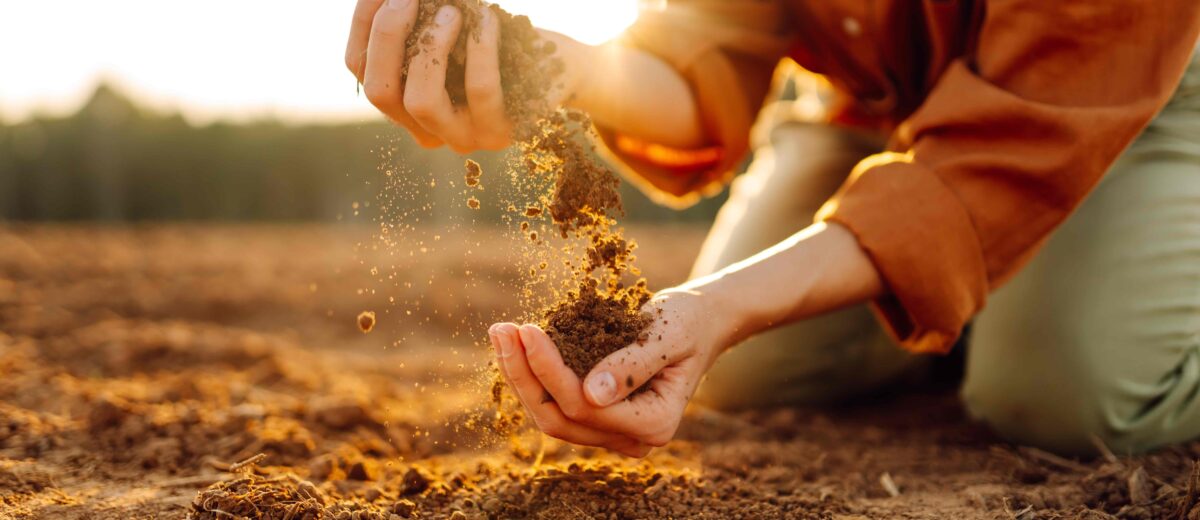
Dig your bare toes into the soil next time you walk in nature. Scoop up a handful of earth and look at it closely. Is it alive and wriggling? Or does it look lifeless and inert?
When we touch earth, we are touching something deeply ancient, deeply alive. It may seem solid and lifeless, but that handful of dirt you scooped up is living substance. Astoundingly it contains more micro-organisms than there are people on our planet!
These microbes break down organic matter, absorb nitrogen, help plants grow, isolate carbon and sustain ecosystems. Without soil, we could not grow food. There would be no forests, no grasslands, no crops, no flowers, no life as we know it.
Yet we degrade this soil daily — through over-farming, deforestation, and pollution. We treat it as dirt, when it is living treasure. To care for the earth is to care for Planet Earth, is to care for ourselves.
When we say ‘Earth’, we might mean the globe spinning in space. Or we might mean the ground under our feet — soil, stone, sand, clay. We might mean the ecosystem that wraps it — forests, mountains, rivers and valleys. All of it matters. All of it is wondrous.
We walk on it. We live off it. We build upon it. And yet, we seldom stop to reflect on the silent wonder that is Earth — both the name of our planet and the substance beneath our feet; the cradle of our existence, the source of everything we need to survive.
Moon dust, for comparison, is not fertile. It lacks organic matter, water and beneficial microorganisms. No other planet or moon in our solar system is able to support plant growth and agriculture without heavy technology. Earth is unique in our solar system for having the right mix of water, air, and warmth on its surface.
Gravity
One of the least appreciated but most essential aspects of Earth is its mass and the force this matter generates: gravity. Without gravity, nothing would stay in place. There would be no up or down, no water held in oceans, no air clinging to the planet’s surface. We would not walk, build, or even breathe.
Gravity gives us weight, but also stability. It holds our bodies together. It holds buildings on foundations. It keeps the moon in orbit, shaping tides and time. It keeps Earth revolving around the sun in a delicate balance of motion and pull. It’s the power behind the solar eclipse we saw this week.
Earth’s mass (about 5.97 × 10²⁴ kilograms) is just right for life. A smaller planet (like Mars) would have too little gravity to retain a thick atmosphere or liquid water. A larger one (like Jupiter) would crush life with its pressure and lack a solid surface. Our Earth is perfectly poised: massive enough to sustain life, yet balanced enough to allow movement, weather, and stability.
Our bodies are attuned to the Earth’s pull. Every step we take, every time we jump, fall, or rest, we are in relationship with this invisible force. It shapes how our muscles develop, how our bones grow, and how our minds orient. In zero gravity, the body weakens. Bones become brittle. Muscles atrophy. We were made for Earth — for its pull, its feel, its embrace. We are not free-floating beings, but rooted ones.
Earthlings
We are not separate from the Earth. We are of the Earth. Many indigenous cultures speak of the Earth as Mother Earth — not as metaphor, but as reality. She feeds us, shelters us, teaches us. In Christian traditions, the Earth is not divine, but it is declared good — a creation worthy of respect and stewardship.
The whole earth’s crust is just a few kilometres thick – but it is where all known life in the whole cosmos exists. Think for a moment about that. Everything we have ever made has come from the Earth. Every meal, every garment, every tool, every device. Even our bodies — made from the minerals, water and organic matter of Earth — return to it when we die. In Genesis, the Hebrew word for human (adam) is linked to the word for ground (adamah). We are earthlings in every sense — shaped from dust, sustained by soil, destined to return to it.
Everything humans have ever done has been done within a few kilometres above, below or on the surface of Earth, with the rare exceptions of space travel. Everything. Work. Worship. Sport. Study. Making love. Child-birth. Travel. Wars. Writing. Shopping. Business…
When we sit at table, we should pause to reflect that everything before us has come from that thin fertile layer of soil on our Earth. A Hebrew table blessing declares: Blessed are You, Lord our God, King of the universe, Who brings forth bread from the earth.
Each meal should stir in us deep gratitude … and wonder.
Till next week,