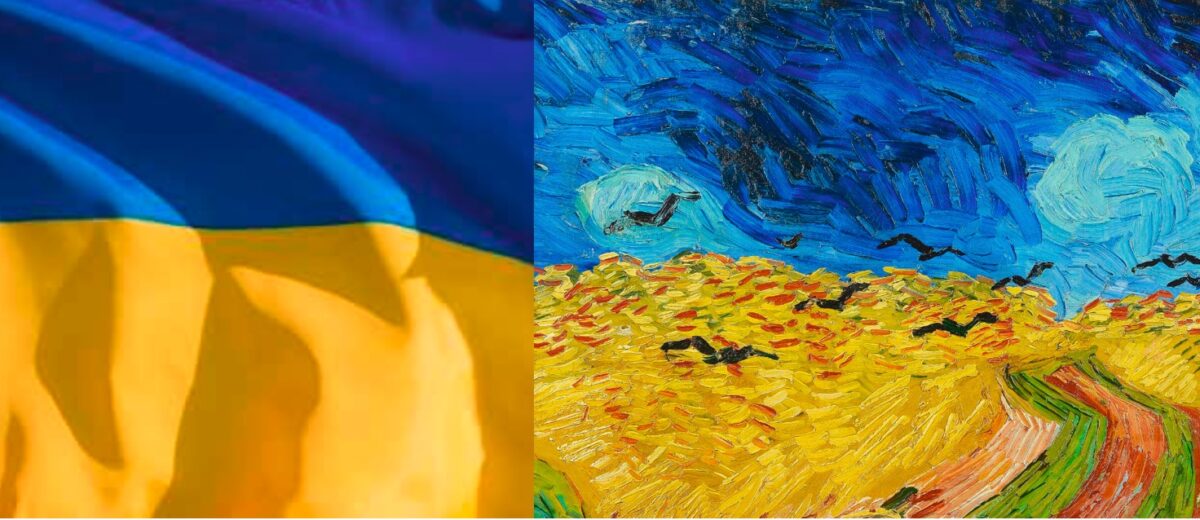
Can the blue and yellow of Ukraine’s flag help us see the relationship between heaven and earth, the spiritual and the material, the vastness of the sky and the fruitfulness of the soil?
Ukraine’s national flag was formally adopted in 1992 following independence from the Soviet Union. Yet the flag’s colours are much older than the modern Ukrainian state. They derive historically from medieval heraldry, including the golden lion on a blue background associated with Galicia, and were adopted by Ukrainian national movements in the nineteenth century.
The familiar interpretation of blue sky over golden wheatfields developed later, particularly in the early twentieth century. While no theological meaning was attached to the choice of these colours, they do nevertheless lend themselves to a profoundly Christian reading. The blue sky suggests the infinite, the eternal, the transcendent, the realm beyond human control. The yellow wheat suggests the earth, human labour, daily bread, harvest and the goodness of creation – the divine immanence.
Interestingly, when introducing a set of commemorative coins, the National Bank of Ukraine has explicitly associated yellow with God’s generosity, alongside the wheat harvest, while blue evokes the boundless sky, peace and dignity. Here is a natural connection with the Lord’s Prayer: Our Father in heaven … Give us today our daily bread. Heaven and bread. Transcendence and immanence. The God beyond us and the God who sustains us.
Horizon
Ukraine’s struggle to preserve its land, people, culture and freedom makes the comparison especially compelling. The yellow wheatfields are rooted in the earth. The blue sky stretches towards infinity. They meet at the horizon where the visible world opens towards the invisible, where the temporal encounters the eternal, where the humdrum and suffering of daily life is imparted with meaning by the eternal.
Immanence in Christian theology means that God is present and active within creation, not simply watching from beyond it. The Incarnation is the ultimate expression of divine immanence: the Word became flesh and dwelt among us. In Ukraine, we might see this divine presence reflected in the everyday faithfulness of farmers who plant, nurses who care, railway workers who keep trains moving, neighbours who shelter strangers, and families who continue to love amid suffering. Not because suffering is itself holy, but because love and goodness can remain present within it.
Transcendence means that God is greater than creation, greater than history, greater than the limits of human understanding. The blue of the Ukrainian flag reminds us that no ruler, government, army or empire has ultimate authority. There is a moral horizon beyond the claims of earthly power. A nation is not God. A state is not God. A ruler is not God. All earthly authority is accountable to a higher justice.
The Christian vision holds both immanence and transcendence together. The God who is above all is also present with us. Theologically, these are not competing qualities of God. They are complementary. If we emphasise only immanence, we risk reducing God to nature, human experience or political causes. If we emphasise only transcendence, God can become remote from human suffering and the responsibilities of daily life. Christian faith holds both together.
When we pray, May your kingdom come, your will be done on earth, in Ukraine, in Russia, in Europe… we are praying for heaven – the fullness of shalom– to come on earth, for the New Jerusalem to come down. Seen this way, the Ukrainian flag instructs our prayers.
Sunflowers
Some have noted Vincent van Gogh’s use of yellow as strongly suggesting divine presence within creation (immanence), and blue as a suggestion of the mystery and vastness of God beyond creation (transcendence). Café terrace at night, for example, reveals a startling Last Supper scene with the waiter as a Christ figure, a cross symbol behind him, serving eleven disciples as the twelfth slips away from the tables. The café is bathed in yellow while the outside dark blue night sky is dominated by two bright stars pointing towards the central figure.
Van Gogh was enamoured with sunflowers – today a symbol of Ukrainian solidarity – and the way they turned to face the light. He associated them with inspiration, friendship and gratitude. One of his last paintings was Wheatfield with crows (1890), golden wheat beneath a dark and threatening blue sky, which itself resembles both the Ukrainian flag and the current Ukrainian situation. Today the golden fields have become battlefields, the blue skies darkened by missiles and drones.
Yet the flag continues to fly. And beckons us to pray for shalom to come on earth.

Till next week,

Very insightful indeed. We are continuing to pray for this situation even though most media have forgotten the suffering of the Ukrainian people and aggression of Russia against a peaceful land. bring this war to an end lord Jesus and protect the Ukrainian people in Jesus name Amen!!