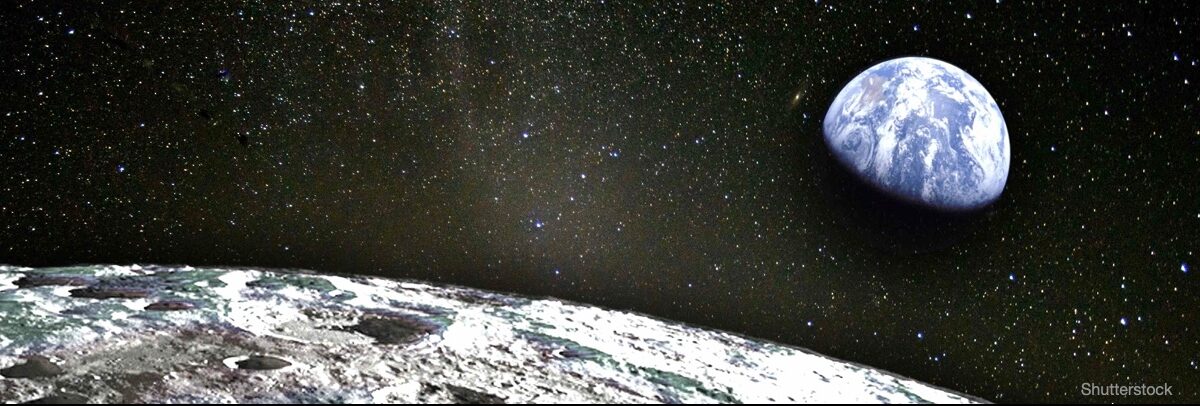
A quiet, serene image from the lunar space capsule of Planet Earth setting over the moon’s horizon offered a curious relief from the apocalyptic threats of violence emanating from Washington this week.
Suspended in the vast blackness, our planet appeared not as a battleground of competing powers, but as a delicate, radiant sphere—fragile yet hospitable and astonishingly alive.
An image to resettle the soul.
From such a distance, the noise of war fades. Borders disappear. A shimmering blue-and-white jewel, wrapped in a thin veil of atmosphere, floats improbably in the cosmic void. The image both humbles and comforts us. For all our fears of collapse and catastrophe, Earth endures—yet it does so with a vulnerability that demands our attention.
This extraordinary planet is the only known place in the cosmos – with its billions of galaxies and trillions of stars – where life flourishes. And in such exuberant abundance. Oceans teem with creatures of every imaginable form. Forests dance in perpetual motion with plants, animals, birds and insects. Even the most unassuming patch of soil is alive with hidden complexity.
For we are told that a single teacup of earth holds more microorganisms than human beings walking this planet! (Unbelievable? Check it out). Beneath our feet lies a universe of life—bacteria, fungi, protozoa—engaged in ceaseless activity, sustaining the very systems upon which we depend. Unlike sterile moon-dust, the ground we tread so casually is a vibrant, living matrix.
Our daily routines are grounded—quite literally—by gravity. Holding us fast to Earth, anchoring every step we take, this invisible force is so constant and so reliable that it escapes our awareness. Everything about our existence is shaped by our bond with the Earth.
All the clothes we have ever worn—whether cotton, wool, or synthetic—originate in the materials of this planet. All the food we have ever eaten is drawn from its soil, waters, and ecosystems. The flowers we have picked, the trees we have climbed, the furniture we’ve sat on—all are gifts of Earth. Even the metals, glass and fabrics in our cars, the rare minerals in our smartphones, the silicon in our laptops—every component has been mined, extracted or refined from the Earth’s crust.
The sight of Earth from space gave the astronauts a feeling of deep connection and responsibility for the planet. Humanity appeared as ‘one people’ on one shared home, they reported. People needed to appreciate our ‘fragile oasis’ and ‘come together regardless of beliefs’, they urged.
The planet’s future
A Russian professor in Amsterdam last week to launch the Dutch edition of his book, Russia Against Modernity, helped me to link the fragility of our ‘spaceship’ and the sharp tensions of our historical moment.
Now based in Vienna, Alexander Etkind described the war in Ukraine as a ‘special operation’ against modernity itself. The war was not only about territory or identity. It was against an emerging world shaped by climate awareness, justice and energy transition. It was about the planet’s future.
Etkind explained how Vladimir Putin’s circles sought to suppress the ongoing transformation of modern societies. Their power rested on fossil fuels—on oil and gas revenues that sustain their private wealth, the Russian state and its geopolitical leverage. Movements toward renewable energy, decarbonisation and ecological responsibility were therefore existential threats to an entire system of power.
This resistance to change expressed itself not only through war, he claimed, but through a broader pattern: support for populist movements, encouragement of climate denialism, electoral interference, economic inequalities and the export of corruption. This helped explain Putin’s affinities with figures such as Trump and Orban, and disruptive political moments like Brexit, as part of a wider pushback against liberal, interconnected and environmentally conscious societies.
He contrasted what he called ‘paleomodernity’—rooted in fossil fuels, extractive economics, concentrated wealth and authoritarian politics—with ‘gaiamodernity’—a still-emerging paradigm shaped by ecological awareness, renewable energy and a recognition of the Earth as a living system with limits that must be respected.
Political leaders who use apocalyptic rhetoric thrive on fear—fear of scarcity, fear of enemies, fear of loss. But the Earth itself tells a more complex story. It speaks of both abundance and fragility: of life multiplying in a teaspoon of soil, and of ecosystems that can be strained, even broken, by human action.
Etkind’s audience heard that if the war in Ukraine was indeed part of a broader struggle over the direction of modernity, then it was also a struggle over how we inhabit this planet. Will we cling to systems that extract and exhaust, or will we move toward ways of living that sustain and renew?
Our awesome, shared home—rare, vulnerable, precious and alive–urges us to see beyond the immediate crises to the deeper realities that bind us together.
Till next week,