A seductive narrative has captured parts of the conservative Christian world: that we need strong nationalist leaders to defend ‘Christian civilisation’ against secular liberalism, moral decline and cultural fragmentation.
In this story, Putin is cast as the guardian of traditional Orthodoxy, while Trump is portrayed as the defender of Christian America. Orban reinforced the same theme during his autocratic rule in Hungary: Christianity fused with nationalism and civilisational struggle.
Yet this rhetoric profoundly distorts the Christian faith. In both Putin’s Russia and Trump-era American nationalism, Christianity is increasingly reshaped into a political religion of grievance, power and militarism — selectively invoking biblical imagery while ignoring the core biblical command to love one’s neighbour.
Most disturbingly, this movement glorifies war and violence. The Christianity projected is more about conquest, dominance, enemies and cultural survival than humility, reconciliation, mercy or peacemaking. Old Testament warfare narratives are elevated while the teachings of Jesus on loving enemies, caring for strangers and blessing peacemakers are ignored.
Under Putin, the alliance between the Kremlin and the Russian Orthodox Church has transformed Orthodoxy into an ideological arm of the state. Patriarch Kirill has repeatedly framed Russia’s war against Ukraine as a ‘sacred struggle’ against Western corruption and moral decadence. Russian soldiers are blessed before thrown into the ‘meat-grinder’ on the frontline.
Nothing symbolises this more starkly than the Cathedral of the Resurrection of Christ outside Moscow, completed in 2020 to commemorate the 75th anniversary of the Soviet victory in World War II. The vast cathedral celebrates Russian military victories with militaristic imagery woven directly into sacred space. It is a monument to national power, not repentance. Christianity is absorbed into the mythology of the state.
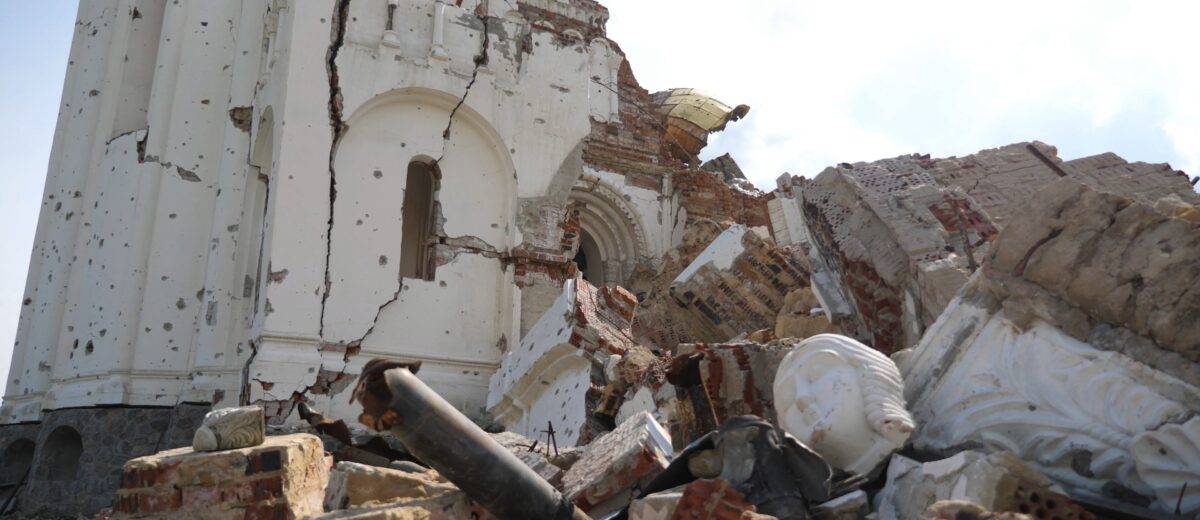
This militarised spirituality stands in direct contradiction to core Christian ethics. In occupied Ukraine, Putin’s men have destroyed or damaged more than 700 church buildings, particularly of Baptist congregations. Christian communities refusing submission to Moscow are treated as enemies, whether Orthodox, Protestant, Catholic or evangelical. Pastors and priests have been abducted, tortured, imprisoned and killed in occupied territories.
‘Christianity’ justifying violence on neighbouring peoples ceases to be the Gospel of Christ.
Cultural warfare
While different in form, the American version is increasingly similar in tone. Around Trump, conservative Christians have embraced a rhetoric of permanent cultural warfare. Political opponents are no longer merely wrong but portrayed as existential enemies of God, nation and civilisation. Public Christianity becomes tied to displays of toughness, dominance, masculinity and patriotic militancy.
Secretary of War(!) Hegseth’s appearance at last weekend’s Rededicate 250 conservative Christian rally in Washington reinforced the perception that a warrior-style, crusading Christianity is gaining influence in nationalist circles. Hegseth has promoted a vision of militant Christian nationalism and civilisational struggle more than repentance, humility or reconciliation.
A Christianity interpreted primarily through conquest narratives neglects the broader biblical trajectory toward justice, mercy and reconciliation. Scripture is mined for images of warriors and kings while both the Hebrew prophets’ repeated calls to protect the stranger and Jesus’ radical command to ‘love your enemies’ are sidelined.
Defend the dignity
Both the Old and New Testaments insist on the dignity of every person created in the image of God. Jesus expands neighbour-love beyond tribe and nation through the parable of the Good Samaritan. The apostle Paul teaches that in Christ ethnic and social divisions are transcended.
Yet nationalist Christianity narrows compassion to one’s own people alone. Outsiders become threats. Immigrants become invaders. Political opponents become enemies of God. Military power becomes a source of spiritual meaning. The cross is wrapped in the flag.
To be fair, many Christians in Europe and America feel genuinely unsettled by aggressive secularism, moral fragmentation and rapid cultural change. They fear the loss of meaning, continuity and moral foundations. Leaders promising order and cultural restoration naturally become attractive.
But of all people, Christians should resist leaders who claim to defend ‘Christian civilisation’ while failing to embody the spirit of Christ: through truthfulness, humility, mercy, justice and love of neighbour. The task of believers is not to sanctify power but to speak truth to power; not to glorify conflict but to seek reconciliation; not to idolise national greatness but to defend the dignity of every person.
Proverbs 6:16 offers a check-list of ‘six things the Lord hates’ by which we can evaluate our leaders: haughty eyes, a lying tongue, hands that shed innocent blood, a heart that devises wicked schemes, feet that are quick to rush into evil, a false witness who pours out lies, and a person who stirs up conflict in the community.
Leaders may claim religious conviction or patriotic virtue, but if their public life is marked by cruelty, deceit, arrogance, vindictiveness, division or lack of self-control, their confession rings hollow.
Pentecost is an appropriate season to apply Paul’s description of the ‘fruit of the Spirit’ to test political leadership: love, joy, peace, patience, kindness, goodness, faithfulness, gentleness and self-control.
P.S. If there are wrong ways for Christians to engage in the public square, what are the right ways? That is what we will explore in the second module of the summer school: Engaging the Public Square, July 20-24. Join Tron Ansaldo, Ed Heger (former PM of Slovakia – via zoom), myself and others for this week in Amsterdam.
Or you could join the week earlier with Engaging the city, July 13-17; or the week later with Engaging Europe, July 27-31.

Till next week,
Thanks Jeff, it is really hard to imagine that many Christians truly believe that Putin and/or Trump are the saviours of Christianity. Good to know that there are still others out there trying to live the true gospel of love and care.
“Old Testament warfare narratives are elevated while the teachings of Jesus on loving enemies, caring for strangers and blessing peacemakers are ignored.”
What is this, the Marcionite heresy reborn?
“Scripture is mined for images of warriors and kings while both the Hebrew prophets’ repeated calls to protect the stranger and Jesus’ radical command to ‘love your enemies’ are sidelined.”
You seem to forget that the OT also denounces foreign enemies (e.g. Amos 1:1-2:3) and even calls for total destruction of some people like the Amalekites for instance. Meanwhile for Jesus, He seem to avoid a foreign woman initially with the blatant explanation that He was for the Jews only (Matthew 15:24), does not seem interested in meeting some Greeks (John 12:20-26) and had no hesitancy in allowing demons to wipe out a herd of pigs that most likely belonged to foreigners (Matthew 8:28–34; Mark 5:1–20; Luke 8:26–39). So nothing wrong with all those.
“Yet nationalist Christianity narrows compassion to one’s own people alone.”
Yeah, so? Even Jesus blatantly refused to help a foreign woman (initially) by explicitly saying He was for His fellow Jews only (Matthew 15:24, also note Matthew 5:10). And Paul if I recall correctly, would first speak to fellow Jews first on his missionary journeys and only after would he witness to Gentiles. So what’s wrong with prioritising your own people first.
“Outsiders become threats. Immigrants become invaders.”
Yes, they ARE a threat, look at all the carnage inflicted by Muslim migrants in Europe already like the bombing of Ariana Grande’s concert and various stabbing and car-ramming incidents. And even ‘Christian’ immigrants maybe no help either. Prize example, Axel Rudakubana, the black African Southport killer who stabbed several white/European girls to death. He came from a black African migrant family that is supposedly Evangelical Christian, and obviously that was of no use.
“Political opponents become enemies of God.”
Excuse me, aren’t they genuinely an enemy of God if they do deliberately support some ungodly stance e.g. pushing the LGBT cause.
“To be fair, many Christians in Europe and America feel genuinely unsettled by aggressive secularism, moral fragmentation and rapid cultural change.”
Indeed, and what exactly did you do to address their concerns? Let me guess, nothing at all, or just go one blathering meaningless platitudes and refusing to hear their concerns. If you refuse to hear their concerns, then don’t be surprised if they turn elsewhere, because you are useless and irrelevant in the situation.
Let me remind you of one recent cultural change, the Muslim Vote (TMV) phenomenon in Britain, brought about ultimately by all the huge numbers of Muslim migrants into Britain. A TMV leader explicitly said that they want to bring Islamic order into Britain (https://christianconcern.com/comment/how-islamic-sectarianism-is-changing-politics-from-below/). If they get their way, then it’s lights out for Christianity and anything else non-Muslim, judging from Islam’s historical precedence whenever Muslims took over an area. What did you do to address this Islamisation? Let me guess, just pretend it’s nothing and look away or worse, aid their goal by keep on supporting destructive migration. If the latter, you deserve utter contempt.