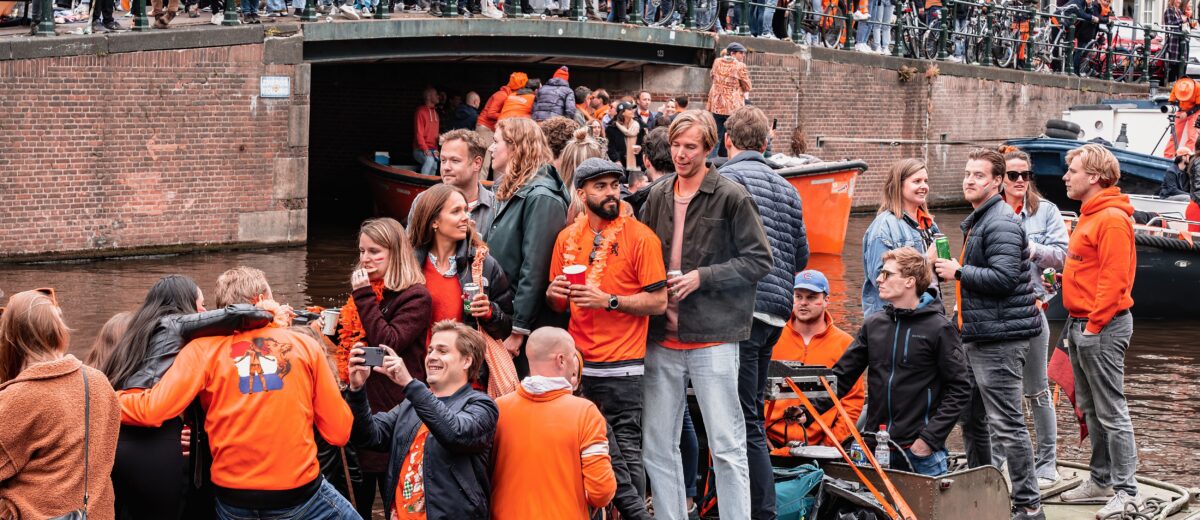
The Dutch will go orange-crazy this coming Monday.
Canals in Amsterdam will overflow with boats crammed with orange-clad merrymakers. Music will fill streets festooned with orange flags. Children will sell old toys and homemade cakes on pavements everywhere. National television will follow the slow procession of royal family members walking among the crowds and playing games with locals, each year in a different city or town – this year Dokkum in the north.
Officially, the Dutch are celebrating King Willem-Alexander’s birthday. Which has always puzzled me. The Dutch are so egalitarian, non-deferential. So why the fuss on Koningsdag?
Well, one doesn’t have to be a monarchist to find reason to celebrate. Some will honour a monarchy tailored to fit a society that distrusts hierarchy. But for many, it has become little more than a licensed carnival—a day of drink, food, extravagance and release in an otherwise orderly society.
Yet the sea of orange tells a deeper story, one all but drowned out by DJs and crowded terraces. The colour is less about loyalty to a current regent than about continuity with a narrative. A small, stubborn people carved out freedom against the odds, and defied tyranny to give birth to the Dutch Republic four centuries ago. Even if few revellers on the canals are consciously reflecting on the Eighty Years’ War, that inheritance still shapes the national psyche.
Brutality
The story of the Dutch triumph of freedom over Spanish imperial tyranny carries contemporary relevance. The parallels with the Ukrainian resistance to Russian imperial tyranny today are striking. And for us all in Europe where democracy is threatened by tyranny from various quarters, it sounds a warning. Freedom requires vigilance and courage to stand against those forces undermining human dignity, equality, justice and truth.
The story goes back to Willem-Alexander’s forefather, William of Orange, a German prince who inherited a principality named Orange in today’s France, then part of the Holy Roman Empire. William had served loyally in the Habsburg court and was no Protestant radical. The trouble began in the 1550’s when the Catholic Spanish Habsburg rulers over the Low Countries provinces – today’s Belgium and the Netherlands – tried to turn back the tide of the Reformation by persecuting Lutherans, Anabaptists, Calvinists and other Protestant dissenters. King Philip II sent the Duke of Alva with an army to crush rebellion. He imposed crippling taxes. He set up an inquisitional Council of Troubles to sentence suspected heretics to death.
William however could not stay silent when saw the ruthless and arrogant brutality of the Spanish troops under Alva. Whole populations of towns – men, women and children – were crowded into the big churches and massacred. Such acts of terror were designed to break the morale of the rebels. Some 60,000 refugees fled to Germany and England.
William called for widespread resistance. Under his leadership, the Dutch were galvanised in their resolve to fight on for their freedom – of conscience, of worship, of self-governance and from fear of tyranny. So began the eighty-year struggle against Spanish tyranny for independence that gave birth to the Dutch Republic. The Dutch national anthem, sung at international sports events, still commemorates William’s resistance.
Inspired
He was inspired by Calvinist theology which viewed resistance not as rebellion, but as faithful obedience to a higher moral order. Not only was it permissible to resist tyranny; it was a Christian duty. Authority that systematically violates justice forfeits its moral legitimacy. Resistance became legitimate when it sought not domination, but the protection of human dignity and communal life.
The Dutch Revolt spanned eight decades of internal divisions, military setbacks, fragile alliances, and repeated attempts at negotiated settlement. Foreign powers hesitated to support the Dutch, fearing destabilisation or escalation. Sound familiar? Yet this unplanned revolution was not merely a national origin story; it is foundational to European ideas of sovereignty, freedom of conscience, and limits on imperial power.
Even before hostilities ended in 1648 with the Treaty of Munster, the Republic had become the global leader in fields of trade, finance, government, shipping, exploration, astronomy, cartography, publishing, international law, toleration and freedom. As the Republic waxed in power and wealth, so Spain’s empire began to wane. A lesson for Mr Putin?
Like William of Orange, Volodymyr Zelensky did not begin as a revolutionary. When Russia invaded Ukraine, Zelensky’s decision to stay helped define the resistance of an entire nation. He has repeatedly declared that Ukrainians are fighting for freedom, dignity and the right to determine their own future.
Freedom requires us all to defy tyranny – by standing for justice, mercy and tolerance in debates over immigration, identity and social cohesion. Whether Dutch or Spanish, Hungarian or American, Ukrainian or British, we all need to stand for freedom by resisting those who undermine inclusion, equality and human rights for all, values rooted in biblical truth.
Freedom should be celebrated – and defended!
Till next week,