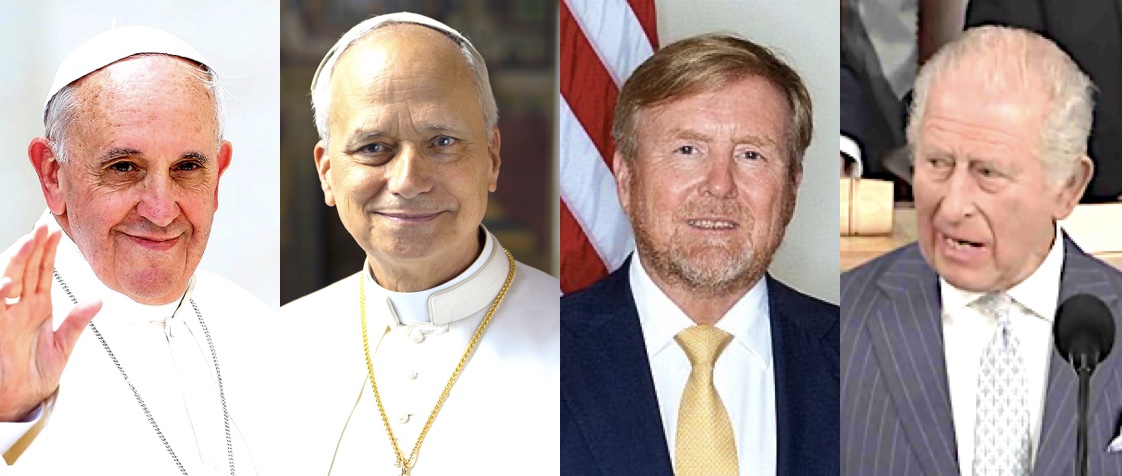
You don’t have to be Catholic or royalist to appreciate the influence of popes and kings in reasserting democratic fundamentals currently under attack from illiberal regimes on both sides of the Atlantic.
Pope Francis, who passed away just a year ago, consistently promoted the rule of law, justice, equality and the common good. He became increasingly direct in confronting what he saw as the global drift toward authoritarian patterns of leadership. He warned repeatedly against the manipulation of democratic mandates to justify illiberal outcomes, cautioning that elections without justice can legitimise oppression rather than restrain it.
He spoke with particular urgency about the erosion of truth in public life. Disinformation, he argued, is not a peripheral issue but a structural threat to democracy itself. When truth becomes negotiable, law becomes pliable, and power begins to operate without accountability.
His consistent defence of migrants, the poor, and those excluded from legal protection was not merely pastoral—it was a sustained critique of systems that claim legality while violating justice.
His legacy now finds sharper expression in the leadership of Pope Leo XIV. Where Francis often spoke in pastoral and prophetic tones, Leo has shown a willingness to engage more directly with political power, including recent exchanges involving the White House. Leo has insisted that the rule of law must not be subordinated to political expediency.
Leo is concerned about the selective application of justice, the politicisation of institutions and policy directions that undermine the equal dignity of persons—particularly in areas such as migration, civil protections and the treatment of vulnerable communities.
A nation cannot claim to defend freedom while weakening the legal and institutional safeguards that make freedom possible, he warns.
Common good
If these two popes have provided a moral and at times confrontational voice, two monarchs have exercised steadying and restraining influence during their recent White House visits, controversial in their own lands.
Dutch King Willem-Alexander, who last summer had hosted the American president in his palace in The Hague, drew on the 400-year Dutch-American friendship before insisting that the rule of law was a shared commitment that underpinned alliances. He stressed inclusivity and the protection of vulnerable groups, and that economic and political systems served the whole of society, not merely segments of it. Here he echoed a distinctly European understanding of the common good—in contrast to the reduction of governance to partisan interests, power or profit alone.
British King Charles III also used the occasion of his US visit to emphasise both the long special British-American relationship, and the need for stewardship, responsibility and social cohesion – counterweights to the fragmentation of democratic life. His insistence on environmental responsibility was not merely ecological; it reminded governments that the common good extends beyond electoral cycles and immediate interests.
Equally important was his consistent affirmation of dignity across difference. By elevating interfaith cooperation and mutual respect, Charles reinforced the cultural preconditions for equality before the law. Without such a foundation, legal equality risks becoming abstract and brittle.
Three takeaways
What, then, do we learn from these two popes and two kings?
First, that democracy cannot survive on elections, laws, and institutions alone. It requires a moral framework—one that insists on truth, justice, and the equal dignity of every person.
Second, that different forms of leadership can converge on the same goal. Francis’s prophetic warnings, Leo XIV’s direct engagement, Willem-Alexander’s diplomatic correction and Charles’s steady reinforcement all point in the same direction: power must be accountable, law must be just and society must remain oriented toward the common good.
Finally, that the correction of democratic drift rarely comes through dramatic confrontation alone. More often, it is the cumulative effect of voices—moral, symbolic, and institutional—refusing to let foundational principles slip into irrelevance.
In a time when democratic confidence is fragile, we need to realise that the renewal of democratic life will depend not only on political reform, but on the recovery of the deeper convictions foundational for such reform.
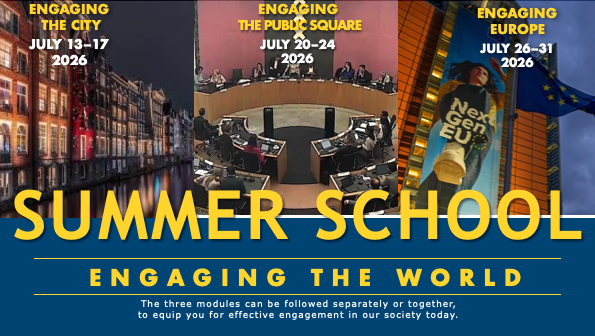
For those of us who are not popes or kings, what role can we play in the recovery of the spiritual values and convictions in our cities, nations and Europe? How can we engage with the city? with the public square? with Europe?
We invite you to join us in our summer school this July with three modules addressing each of these arenas. The modules can be followed separately or together. Accommodation for those needing it will be in De Poort, the YWAM centre in Amsterdam. Our website page will be completed this coming week but registration is already available here: ywamamsterdam.com/engage
Europe Day
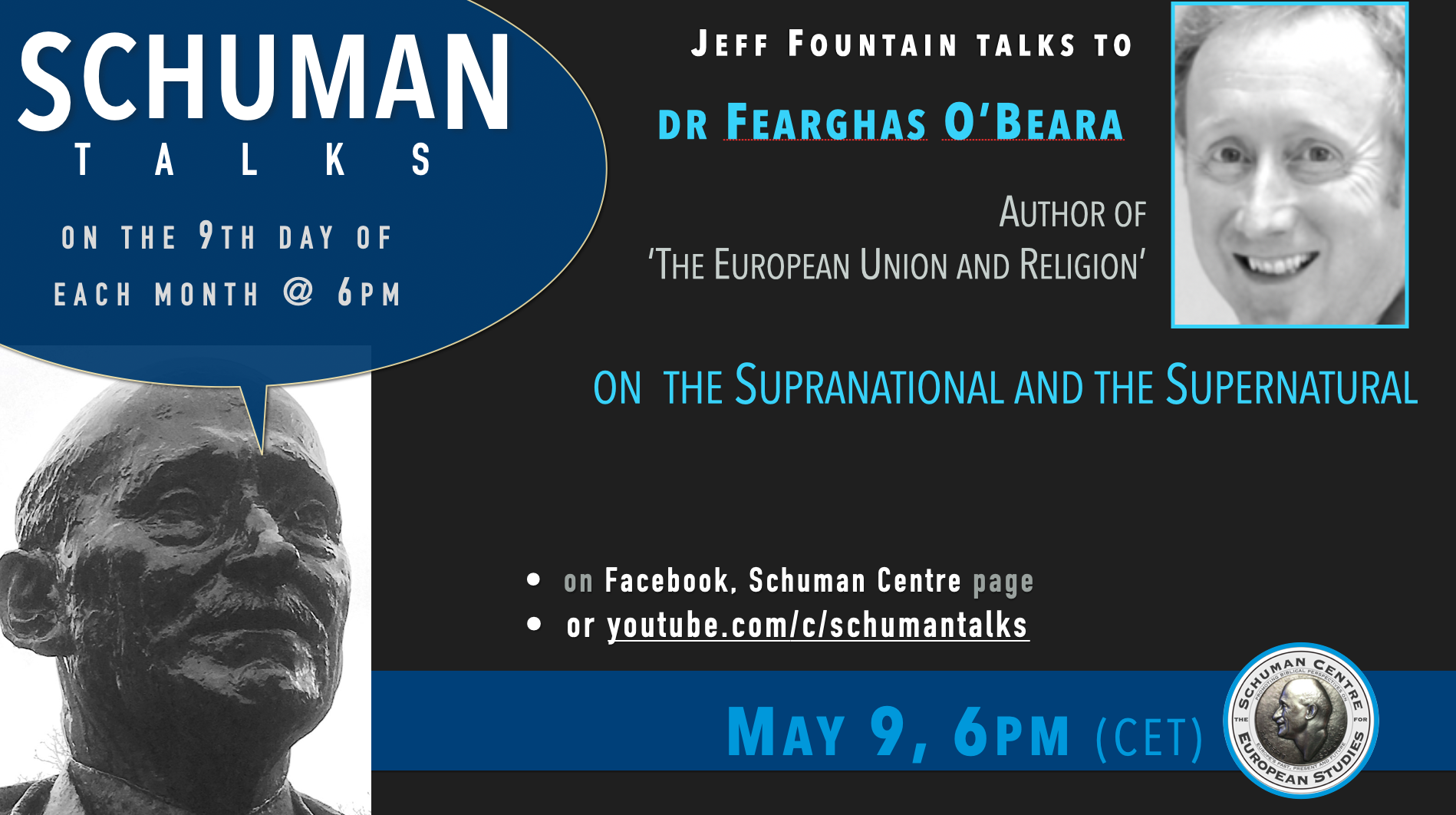
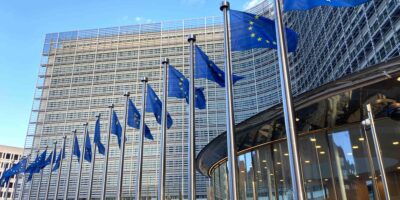
Next Saturday, May 9, is Europe Day, a day to reflect on how we can recover these deeper convictions. On this day, in 1950, the French Foreign Minister, Robert Schuman, gave a three-minute speech which launched the process of European integration rooted in the principles of the rule of law, justice, equality and the common good. Since 2011, the Schuman Centre has held the State of Europe Forum in the capital of the country holding the European presidency. Which is currently Cyprus.
However, as previously announced, we have suspended this tradition due to increased involvement in activities concerning Ukraine, and recalibration of our focus on the recovery of the ‘soul of Europe’, with Ukraine as a ‘laboratory’. Commemorating Europe Day and the Schuman Declaration, we will bring 20 young YWAMers from Stockholm and Amsterdam to Brussels for a Together for Europe event, May 11-13, with 130 other European youth exploring how to revive ‘a soul for reconciliation’.
Till next week,
orb7mq