Montenegro’s journey towards a new European identity
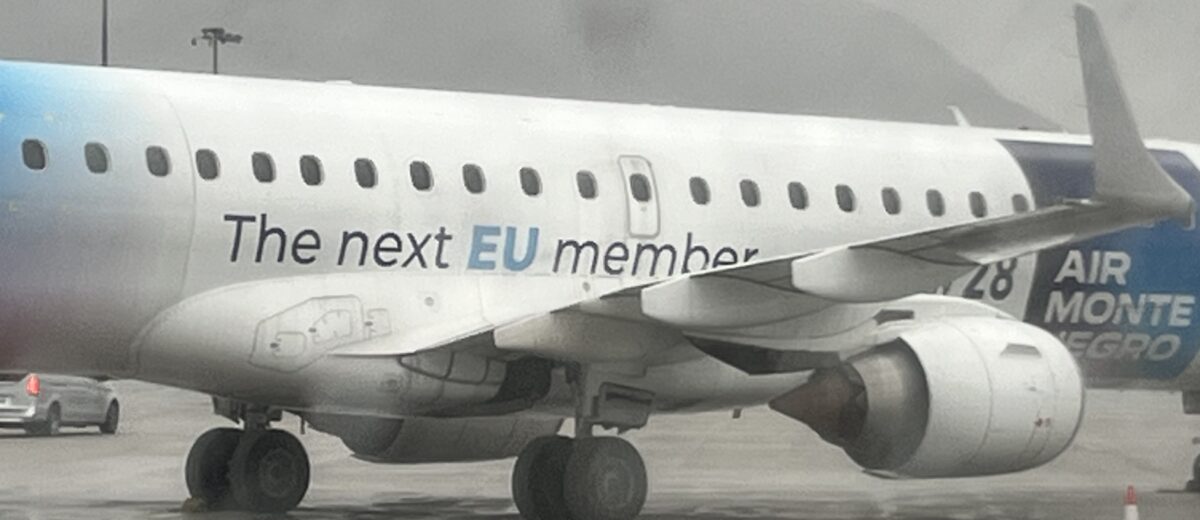
As our plane taxied towards the terminal of Tivat airport, the aircraft outside my window confirmed that the little nation where we had just landed was on track to become the next member of the European Union.
Nestled between the mountains of the Balkans and the (normally) blue waters of the Adriatic, and squeezed between Croatia and Albania, Montenegro is one of Europe’s smallest countries. (I happened to time my first visit to this nation of barely 630,000 people with fierce rain and wind creating wild brownish waves capped with white). Part of Serbia until 2006, Montenegro hopes to become the 28th member of the EU as early as 2028. Accession negotiations could be completed as early as next month, if Croatia can be persuaded not to throw a spanner in the works. For Croatia is demanding that Montenegro pay prisoner-of-war compensation, prosecute war crimes, resolve property and maritime border disputes, return the training ship Jadran, search for 14 missing persons from the 1991–1995 war, and preserve the Morinj camp memorial plaque.
Montenegro’s journey towards Europe is a story about the transformation of a society: from a past marked by tribal loyalties, blood feuds and historical grievances towards a future built on the rule of law, democratic institutions and reconciliation. For centuries, parts of the Montenegrin highlands were governed by customary laws and powerful clan loyalties. Where justice was weak or absent, families could take justice into their own hands. A killing might initiate a blood feud, with revenge demanded across generations. Honour had to be defended, insults answered and blood avenged.
Yet there is another side to this history. Traditional Montenegrin communities also developed elaborate practices of peacemaking. Mediators, clan leaders and sometimes groups of women known as ‘carriers of peace’ worked to end feuds. Reconciliation involved public gestures, promises, compensation and forgiveness. The aspiration was expressed in the remarkable possibility that an enemy might once again become a brother.
What a transformation that represents!
Today, Montenegro is attempting something similar at the level of national institutions. Rather than allowing power, political patronage and personal loyalties to determine outcomes, as unfortunately has been the recent trend in the United States, it is building systems in which justice should be independent, corruption prosecuted and citizens treated equally before the law.
The European Commission’s November 2026 assessment records substantial progress. All 33 negotiating chapters have been opened, and 21 provisionally closed. Reforms have strengthened judicial independence, public administration, electoral procedures and the prosecution of high-level corruption. Montenegro has also made progress in investigating war crimes, an important contribution to confronting the legacy of the Yugoslav conflicts.
There is still much to do. Political polarisation, organised crime, corruption, media intimidation and discrimination remain concerns. The challenge is no longer simply to pass European legislation, but to make European principles part of everyday life. Montenegro’s European journey is therefore about more than changing laws. It is about changing the way people relate to one another.
But what about the spiritual foundations of this transformation?
With a landscape dotted with ancient monasteries, churches and mosques, Montenegro is certainly not a spiritually empty country. Over 70 per cent of its population identify as Orthodox Christians, almost 20 per cent as Muslim and just over 3 per cent as Catholic. Christianity and Islam have both left deep marks on its cultural inheritance. Yet the religious picture is complicated. The Orthodox majority is divided between the Serbian Orthodox Church and the smaller Montenegrin Orthodox Church. Their differences are closely connected to competing understandings of national identity, history and Montenegro’s relationship with Serbia. As elsewhere in the Balkans, faith can become intertwined with national identity and political loyalties. Religion, which should help people transcend their divisions, can sometimes reinforce them.
There are nevertheless important traditions of coexistence. Orthodox Christians, Muslims and Catholics have shared this small country for generations. The presence of different religious communities is a reminder that Montenegro’s future cannot be built around one ethnic or religious identity alone. The European project offers an important framework here. EU values of freedom of conscience, religious liberty, rule of law, equality before the law and respect for minorities express a vision of human dignity rooted deeply in Europe’s Christian heritage.
Can a country become ‘European’ simply by adopting European standards? Does legislation alone produce reconciliation? The Bible requires outward transformation to be accompanied by inward renewal. Paul reminds us that reconciliation is not simply the absence of hostility but the creation of a new relationship.
Montenegro’s journey offers a lesson for the rest of Europe. We too have inherited centuries of religious conflict, national rivalries, political vengeance and unresolved historical grievances. Our institutions may be more developed, but the temptation to demonise opponents, nurse grievances and seek retribution remains very much alive. Montenegro’s success will depend not only on the quality of its institutions but on whether its people can build a society in which justice replaces revenge, forgiveness overcomes bitterness, and differences become a source of mutual enrichment rather than division
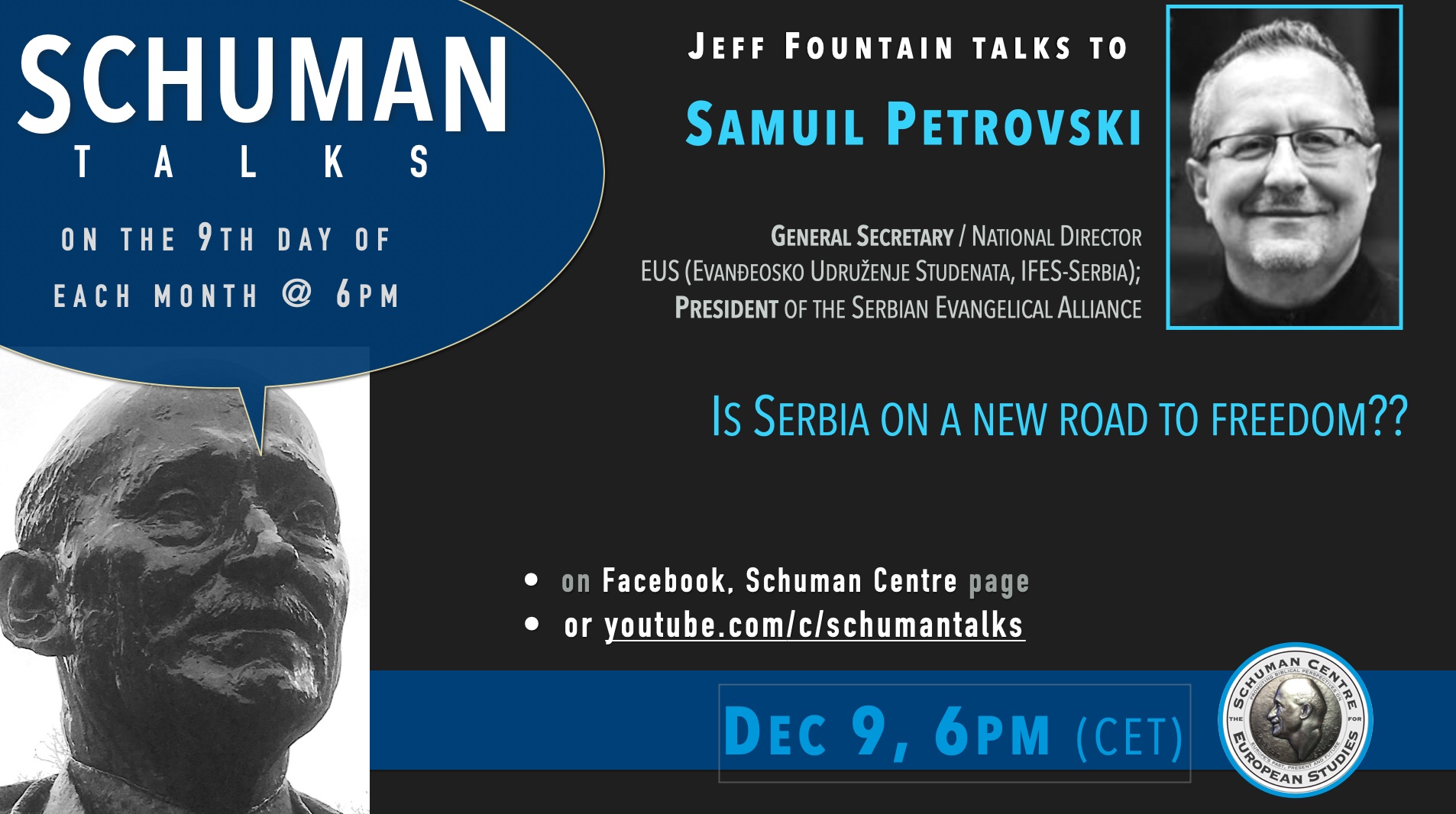
Hear on the spot reports from Serbia’s Samuil Petrovski on what the student protests have achieved and what that can mean for Serbia’s future. Wednesday, Dec 9, 6pm CET, YouTube.com/c/schumantalks
Till next week,