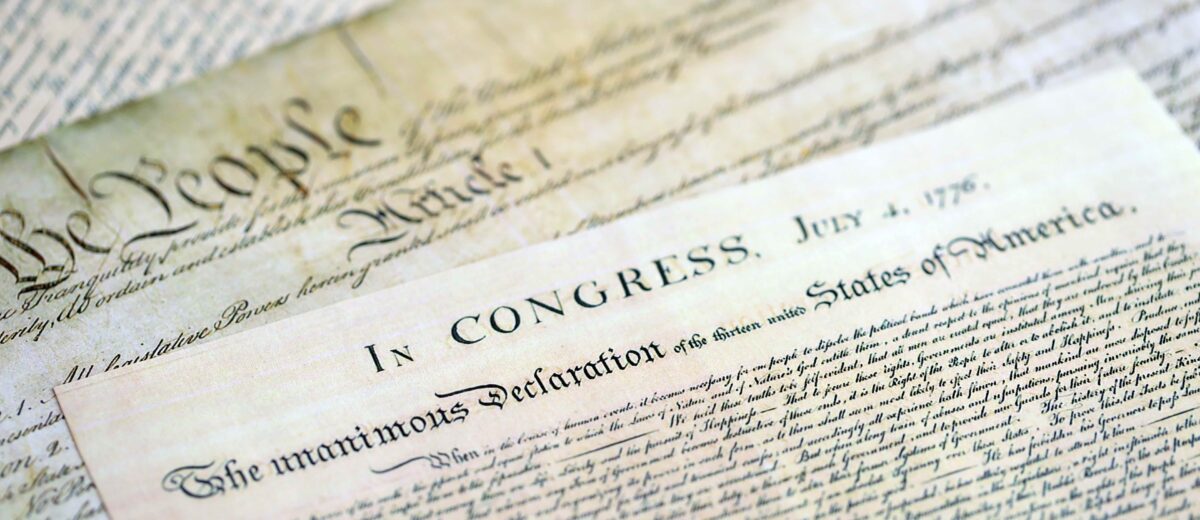
The 250th anniversary of American independence today is a timely occasion to reflect on the human journey from dependence to independence and to interdependence – among individuals, communities and nations.
Many Americans are wondering about the future of their democracy. Ukrainians are fighting for their independence from imperial Russia. Britons are questioning the wisdom of Brexit a decade later. And European Union leaders are debating the pros and cons of expansion.
It’s a good time to ask what we should learn from this remarkable American experiment not only in becoming independent, but also interdependent. For independence is not the high point of maturity. Our modern western cultural celebration of radical autonomy equates freedom with complete self-determination. Yet the ‘I-need-nobody’ attitude ironically often leads to loneliness and forms of addiction.
As individuals, as with nations, each of us has had to learn to grow in personal maturity. We start from dependence on our parents and family in particular, and then learn independence as teenagers, accepting responsibility for ourselves. We need to mature into interdependent persons, capable of living independently but choosing mutual relationships; both to give and receive; to be neither controlling nor controlled.
The divine intention for the broader human family is for individuals, communities and nations to be rightly related one to another. No modern nation controls financial markets, migration, energy security, climate, digital technology, organised crime or military threats entirely on its own.
How to live together
Independence Day could equally be called Interdependence Day. For the thirteen original American colonies had to find a way to live together after independence from imperial Britain – without becoming either thirteen separate nations or a new centralised empire. Their experiment succeeded because they found a framework for healthy interdependence among themselves, despite their religious diversity.
Massachusetts had strong Puritan roots. Virginia was largely Anglican. Pennsylvania was founded by William Penn as a haven for Quakers and other dissenters. Maryland was originally established as a refuge for English Catholics. Rhode Island, founded by the erstwhile-Baptist Roger Williams, became a pioneering experiment in religious liberty. New York inherited Dutch traditions of relative religious pluralism.
It was practically impossible to establish one national church. The founders thus sought a political order in which different Christian traditions—and eventually people of other faiths and none—could coexist peacefully. The answer they developed drew from several streams of European thought.
The Protestant Reformation emphasised the dignity and responsibility of individual conscience before God. The Dutch Republic demonstrated that a relatively plural society could flourish economically and politically. The English constitutional tradition contributed ideas about the rule of law and limited government. Enlightenment figures like John Locke articulated theories of natural rights and government by consent. These ideas were then integrated in an off-shore ‘European’ experiment, if you like, in the distinct context of North America.
A key principle was to separate church and state. That did not mean a strict exclusion of religion from public life as is often assumed today. But it challenged the European assumption that political unity required religious unity. Influenced by reformers such as John Calvin, they saw that different institutions possessed distinct God-given responsibilities. The government cannot control the Church. Neither can one denomination capture the government. Both institutions retain their own authority.
Later thinkers like Abraham Kuyper would describe this as ‘sphere sovereignty’. Church and state were to be institutionally independent in order to relate to one another without domination. In relational terms, they sought interdependence, neither fusion nor hostility.
We can all learn from the remarkable American founding because it combined both political independence from imperial rule and constitutional interdependence among sovereign states. Liberty was constrained by law and moral responsibility.
Freedom is relational
The ongoing European project of interdependence among nations with long and complex histories mirrors in some ways the original American project integrating the thirteen states. Europe Day, May 9, is really Europe’s Interdependence Day. Europe may need to rediscover that successful interdependence requires strong local identities, democratic legitimacy and the willing consent of its member states rather than bureaucratic centralisation. The British are rethinking the assumption that sovereignty means freedom from interdependence. Watch this space.
A healthy American future demands the rediscovery that freedom depends upon institutions limiting one another rather than upon the strength of a single leader. America led the way after World War Two in promoting institutions of interdependence on the global scene such as the UN, NATO and WHO among others. Falling back on independence and isolationism is not the way towards peace. While declaring her need for no one else given her own military strength, America’s independent action in the current conflict with Iran has yet revealed a vulnerability patently obvious to much of the world.
Ukraine fights for independence from the autocratic rule of the Kremlin, while developing strong interdependent ties with European allies slowly awakening to their need of a resilient Ukraine. Yet her future internally will require the ongoing development of national institutions of trust and mutual accountability.
Healthy societies, including the community of nations, resemble living bodies more than mechanical systems: every part has integrity, yet no part flourishes in isolation. We all need to learn that freedom is relational.
Till next week,