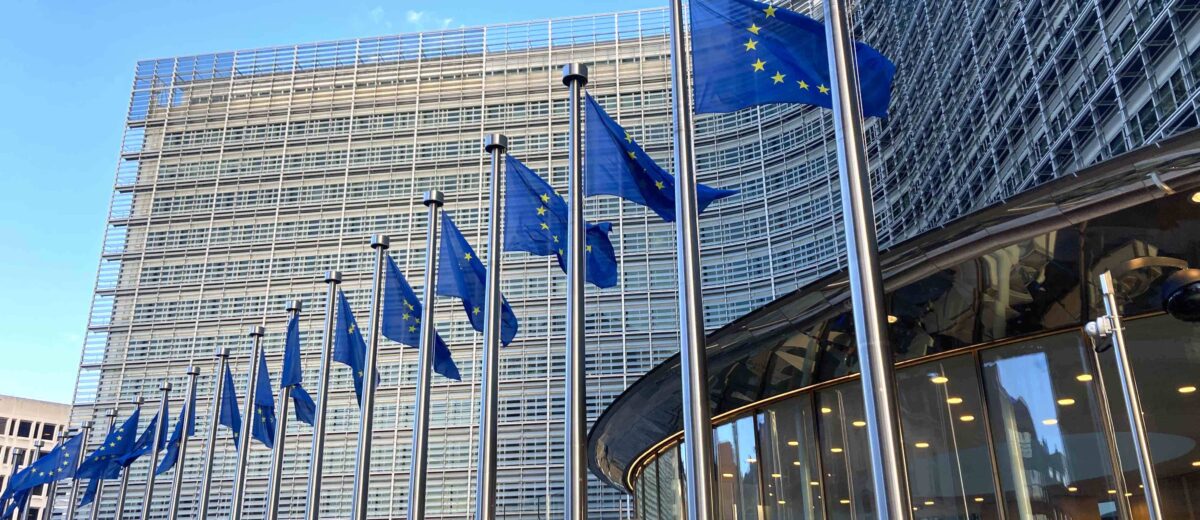
“Happy anniversary!” Today is ‘Europe’s’ 76th birthday.
You hadn’t noticed?
Few European nations make much fuss about “Europe Day”, May 9. Yet it is the birthday of the European integration project. Since then, the countries of the European Union have avoided war among themselves — unprecedented in European history.
Exactly 76 years ago today, the French foreign minister Robert Schuman presented a visionary proposal in a three minute speech – almost as short as the weather report – which laid the foundations for today’s European Union.
That speech, known as the Schuman Declaration, was not merely an economic initiative about coal and steel. It was a moral and civilisational vision shaped by Christian values of forgiveness and reconciliation, and of human beings created in God’s image and thus bearing dignity. Nations once addicted to war became partners in peace. Former dictatorships became democracies. Former enemies became allies. Borders softened. Students crossed frontiers freely. Millions of Europeans grew up taking peace for granted because earlier generations deliberately built institutions to protect it.
This was the start of the most successful peace-building project in modern history. After centuries of war — culminating in two catastrophic world wars — European nations chose cooperation over revenge, interdependence over nationalism, and reconciliation over perpetual conflict. And it worked.
A good name for this day would be ‘Interdependence day’, when Europeans began to practice cooperation, and pursue the common good rather than ‘our country first’.
Yet outside Brussels, Strasbourg, Luxembourg and a scattering of schools or official ceremonies, most Europeans barely notice it. For Europe Day struggles for recognition in a crowded early May calendar. Labour Day on May 1 remains deeply embedded in national cultures. The Dutch have just wildly celebrated King’s Day (April 27) and commemorated both Remembrance Day on May 4, and Liberation Day on the 5th. The UK commemorated VE Day yesterday, May 8. Ascension Day and Pentecost also often fall in early May.
Most ironically, May 9 also carries the heavy legacy of Soviet Victory Day, when long-past German atrocities continue to be recalled in stark contrast to western attitudes. Although imprisoned by the Nazis during the war, Schuman smuggled out notes to the French resistance telling them that ‘we French will have to learn to love and forgive the Germans to rebuild Europe after the war’.
Taken for granted
This forgotten birthday matters precisely because Europe itself is often taken for granted.
Many Europeans enjoy the fruits of European integration without knowing much about its origins. Surveys repeatedly show that trust in the EU is at its highest level since 2007, driven partly by renewed awareness of the fragility of peace after Russia’s invasion of Ukraine. Europeans increasingly see the Union not merely as a market or bureaucracy, but as a protector of democracy, security and shared values. Yet understanding of EU institutions. civic participation and the source of ‘European values’ remains surprisingly weak.
That rediscovery of values is important. For many years, Europe’s story was framed largely in economic or technocratic terms: regulations, currencies, trade agreements and institutions. But a deeper conversation is re-emerging about Europe’s moral and spiritual foundations.
A new book by Fearghas O’Beara, The European Union and Religion, will be released next month with surprising findings. The first headings in the book read: ‘making sense of the EU’s plunge into the sacred pool’ and ‘The EU (re)discovers religion’.
With a name that betrays his Irish identity, Fearghas has worked within the EU for 28 years, mainly in Brussels where among other roles he was advisor to two presidents of the European Parliament, and is now the Head of the European Parliament Office in Ireland.We have known each other since 2012.
Carriers of values
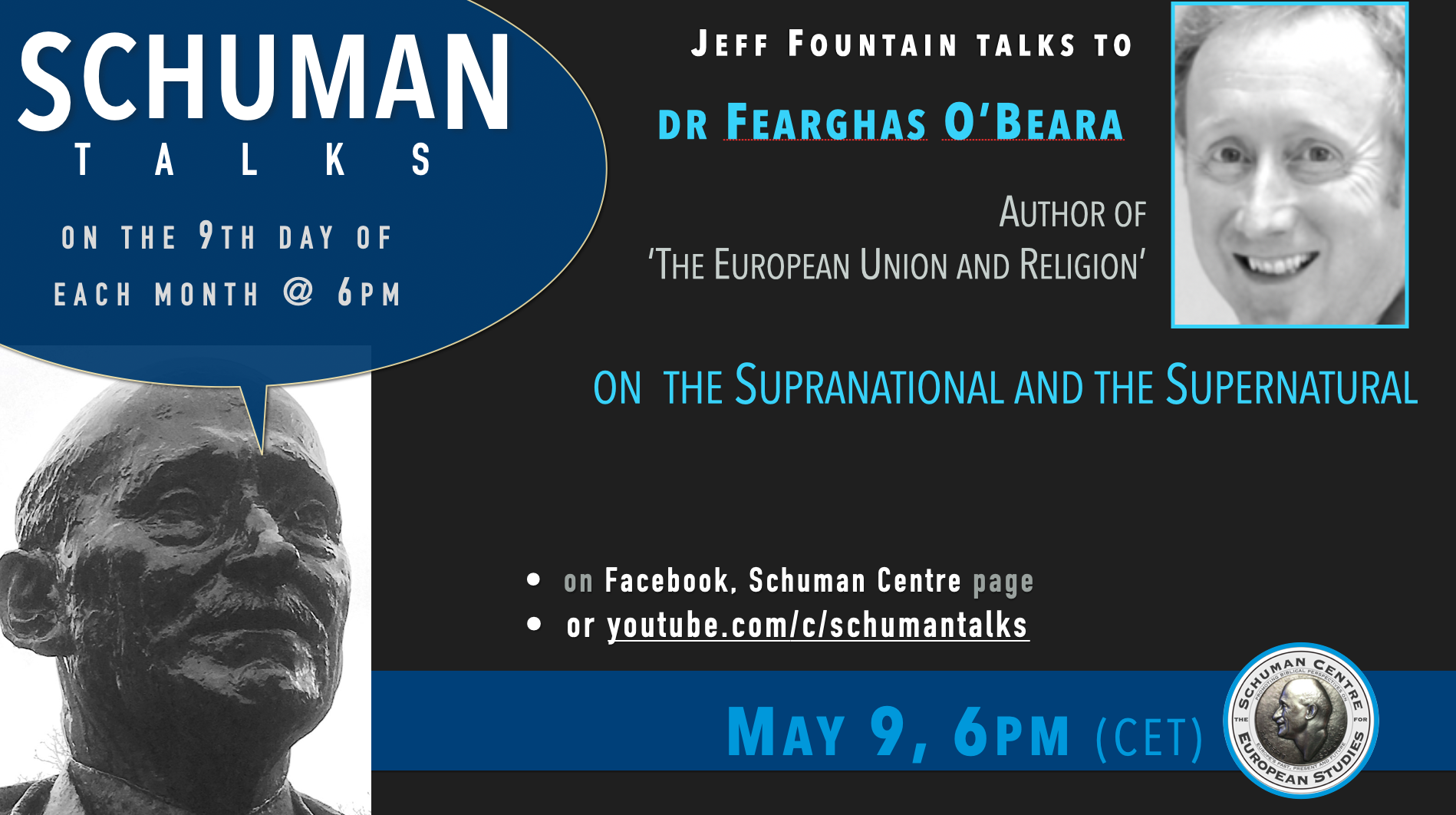
Fearghas is my guest tonight on this month’s Schuman Talk where we will discuss his findings and their implications. A long era of exclusive secularisation has given way to increasing recognition in EU circles of the continuing importance of religion in public life.
This is a striking development. The original European project was often presented as pragmatic and economic. Religion seemed destined to retreat into the private sphere. Yet Fearghas shows that the opposite has occurred: religion has gradually ‘seeped into the EU legal order,’ especially since the Lisbon Treaty of 2009 created formal structures for dialogue between EU institutions and churches and religious communities.
Why? Because Europe increasingly understands that societies cannot survive on economics alone. The EU speaks often about ‘European values’ — human dignity, solidarity, democracy, reconciliation, human rights, care for the vulnerable. But values do not emerge from nowhere. They are carried through culture, memory, philosophy and religious traditions. As Fearghas notes, EU institutions have come to view religious communities as important ‘carriers of values’ and contributors to European identity and democratic legitimacy.
Europe Day therefore deserves more than perfunctory flag-waving. Europe Day is the birthday of reconciliation — and birthdays matter because they remind us who we are.
Till next week,