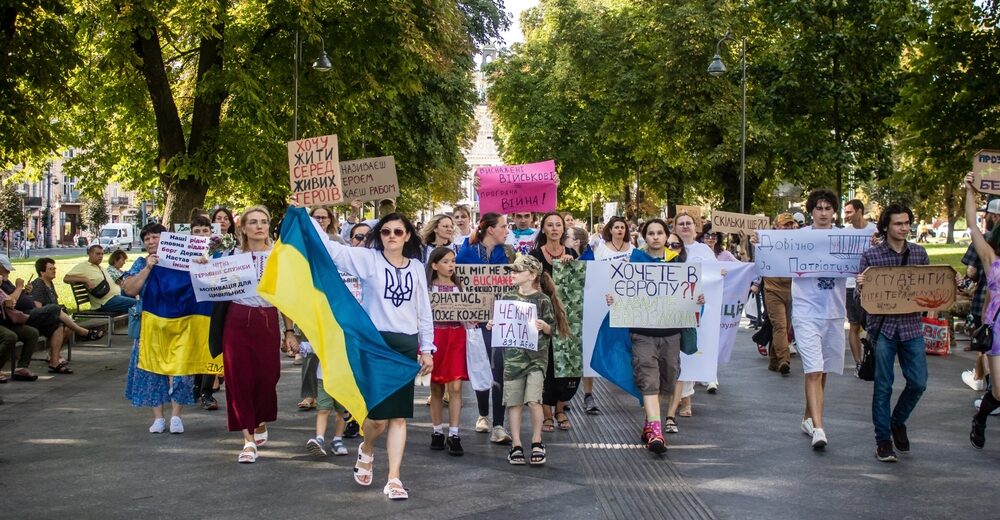
Recent protests in Ukraine against government decisions affecting key anti-corruption and defence institutions may look like dangerous dissent undermining national unity and the war effort.
In actuality, they demonstrate the remarkable strength of the nation’s civil society, in sharp contrast to their Russian neighbours. And they carry lessons for us in Europe and America.
Even in wartime, Ukrainians still took to the streets to defend the integrity of the state. And the Zelensky administration responded by revising its approach. That is remarkable. It shows that Ukraine is not simply fighting for survival; it is also preserving the civic habits that make survival meaningful.
This spirit did not appear overnight. It has roots in Ukraine’s modern history, especially in the Orange Revolution of 2004 and, even more decisively, in the Revolution of Dignity—the Maidan protests of 2013–14. Those movements were not just against particular leaders. They asserted that government derives legitimacy from free citizens, and that Ukrainians were prepared to defend the rule of law, transparency and European democratic values.
That Maidan experience became part of Ukraine’s political DNA. It explains why volunteers mobilised long before governments did after the invasion of February 2022. It explains why churches, charities, neighbourhood groups, entrepreneurs, veterans, journalists and ordinary citizens have become indispensable to the country’s defence. Ukraine’s resilience does not rest only in ministries or military headquarters. It rests in countless independent initiatives that act without waiting for permission.
A healthy democracy depends not only on effective government and a functioning economy, but on a vibrant civil society—the networks of trust and cooperation that make self-government possible.
Sharp contrast
The contrast with Russia could hardly be sharper. Over the past two decades, independent civic organisations there have been systematically dismantled. Human rights groups have been branded ‘foreign agents’, independent media muzzled, opposition figures imprisoned, exiled and murdered, and public protest made nearly impossible. The result is a state that looks strong but is in fact brittle. When citizens cannot speak freely, governments stop learning. When independent institutions disappear, corruption spreads. When fear replaces participation, strategic mistakes multiply.
Ukraine, by contrast, remains noisy. Its politics are often untidy, its media vigorous, its activists demanding and its governments sometimes forced to reverse course. To some observers this looks chaotic. In reality, it is a sign of democratic strength. The willingness of citizens to challenge authority peacefully—and the willingness of government to listen—is not a weakness to be corrected after the war. It is one of the reasons Ukraine not only has endured the war but is beginning to prevail.
For Europe, the message to be heard is that security depends not only on weapons, intelligence and alliances, but on the civic fabric that binds a free society together. Churches, universities, voluntary associations, independent journalism and local communities cultivate the habits of responsibility and participation on which democratic resilience depends.
Democracy is not merely a constitutional arrangement. It is a living culture sustained by active citizens. Look at the photo above. Who do we see? Housewives, shopkeepers, school kids, students,… Everybody plays a part.
There is also a lesson here for the United States. Americans rightly celebrate their 250th birthday, their constitution, the separation of powers and long democratic tradition. But these institutions ultimately depend upon civic habits that no constitution alone can guarantee. Whenever political leaders seek to intimidate or delegitimise independent media, pressure universities and schools to conform to official narratives, discourage open public debate, or sow persistent distrust in the integrity of elections without compelling evidence, they weaken the very civic culture upon which democracy depends.
Ukraine’s experience demonstrates that democracy is sustained not simply by periodic elections but by citizens who remain organised, informed and willing to speak truth to power—even when their own government is led by leaders they support and even while the nation is at war. The paradox is striking: a country fighting for its survival is reminding the world’s oldest modern democracy that the surest safeguard against autocracy is not a strong leader but a strong civil society.
Deeper roots
The vibrant Ukrainian civil society has even deeper roots stretching back centuries. Long before the Soviet Union, the Cossacks cultivated an ethos of self-government on the Ukrainian steppe. Their leaders (hetmans) were elected, military councils debated important decisions, and authority depended upon consent as much as coercion. Ukrainians remember the Cossacks not simply as warriors but as free people who governed themselves. This memory remained alive in literature, folklore and national identity.
Ukraine was never governed exclusively from Moscow. Different regions lived under the Polish-Lithuanian Commonwealth, the Habsburg Empire, the Ottoman sphere and the Russian Empire. These overlapping influences exposed Ukrainians to different legal traditions, municipal rights, churches and educational institutions.
Churches too played a larger role than is often recognised, as schools of civil society. The Ukrainian Greek Catholic Church survived underground during Soviet rule. For over forty years it maintained networks of trust, mutual assistance and quiet resistance. Its clandestine existence taught ordinary believers how to organise outside state control. The Orthodox churches also became increasingly involved in public life after independence, while Protestant communities expanded rapidly during the late Soviet and post-Soviet years. Evangelical churches pioneered rehabilitation programmes, youth work, education and humanitarian ministries, often promoting Western ideas of voluntary association.
Ukrainians have learned that freedom did not originate with the state. It was cultivated within society itself. Churches, voluntary associations, neighbourhoods, educational institutions and local communities taught people how to trust one another, deliberate together and assume responsibility for the common good.
Ukraine’s resilience today owes as much to the strength of its civil society as to the courage of its armed forces.
Till next week,